초월을 통한 발견
Discovery through Transcendence
단하주단을 이끄는 한복 디자이너 단하는 한복을 전통 의상의 틀에 가두지 않고 현대적인 감각으로 재해석한다. 전통에서 유래한 문양을 활용해 한국적인 정체성을 표현하면서 동시에 젠더리스 한복을 시도하고, 속옷을 아우터로 디자인하는 등 경계를 넘나드는 디자인을 선보인다. 그는 지금이야말로 장롱 속 한복이 고정관념을 뛰어넘어 새로운 역사를 만들어가는 시기라고 말한다.
Hanbok designer Danha, who heads up Maison Danha, reinterprets hanbok with a modern sense of style without pigeonholing the garment in the frame of traditional costumes. She uses traditional patterns to express Korean identity, while at the same time experimenting with genderless hanbok and designing underwear as outerwear to present cross-border designs. She says now is the time for that hanbok in the closet to overcome old stereotypes and write a new history all its own.
About the Interviewee
단하는 전통을 새롭게 해석한 한복으로 주목받는 한복 디자이너다. 2018년 단하주단을 론칭했다. 2020년 K팝 아티스트 블랙핑크가 단하주단의 옷을 입고 뮤직비디오에 출연하면서 한복에 대한 전 세계적인 관심을 끌어냈다. 2021년 문화체육관광부 장관상 ‘올해의 한복인’을 수상했고 한국바른언론인협회가 국가 위상을 높인 공로자에게 수여하는 ‘위대한 국민대상’ 및 ‘대한민국 크리에이터 대상’을 수상했다. 최근 ‘파리패션위크Paris Fashion Week’에서 한복 컬렉션을 선보이며 좋은 반응을 얻었다.
Since launching Maison Danha in 2018, Danha has been garnering a lot of attention with her new interpretation of tradition as a hanbok designer. In 2020, K-pop artists BLACKPINK appeared in a music video wearing outfits from Maison Danha, drawing worldwide interest in hanbok. In 2021, she was selected as the Hanbok Person of the Year, a commendation given out by the Minister of Culture, Sports and Tourism. That same year, she was also the recipient of a Great Korean Citizen Award, a citation presented by the Association of Righteous Korean Journalists to people who have contributed to promoting Korea’s status on the world stage, as well as a Korea Creator Award. Recently, Danha showed her hanbok collection at Paris Fashion Week, and received favorable reviews from many people and media outlets.
Q1.
세계 무대에서 K패션에 대한 관심이 높아졌어요. 지난가을 파리패션위크에서 한복 컬렉션을 선보이셨는데요.
Q1.
Interest in K-fashion has increased on the world stage. You presented your hanbok collection at Paris Fashion Week last fall. Can you tell us about it?
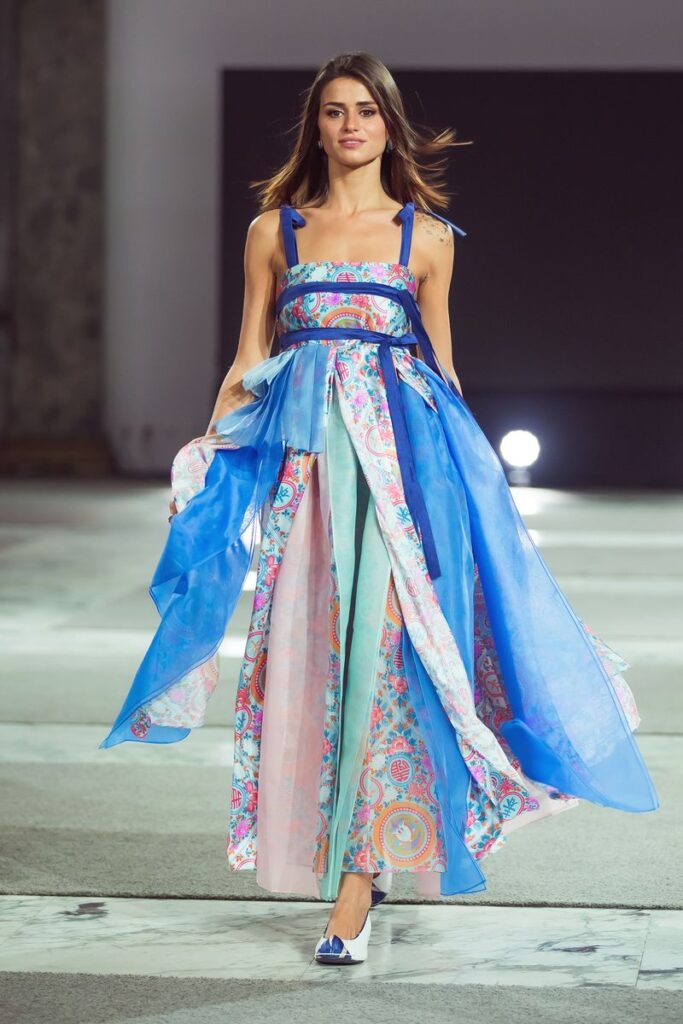
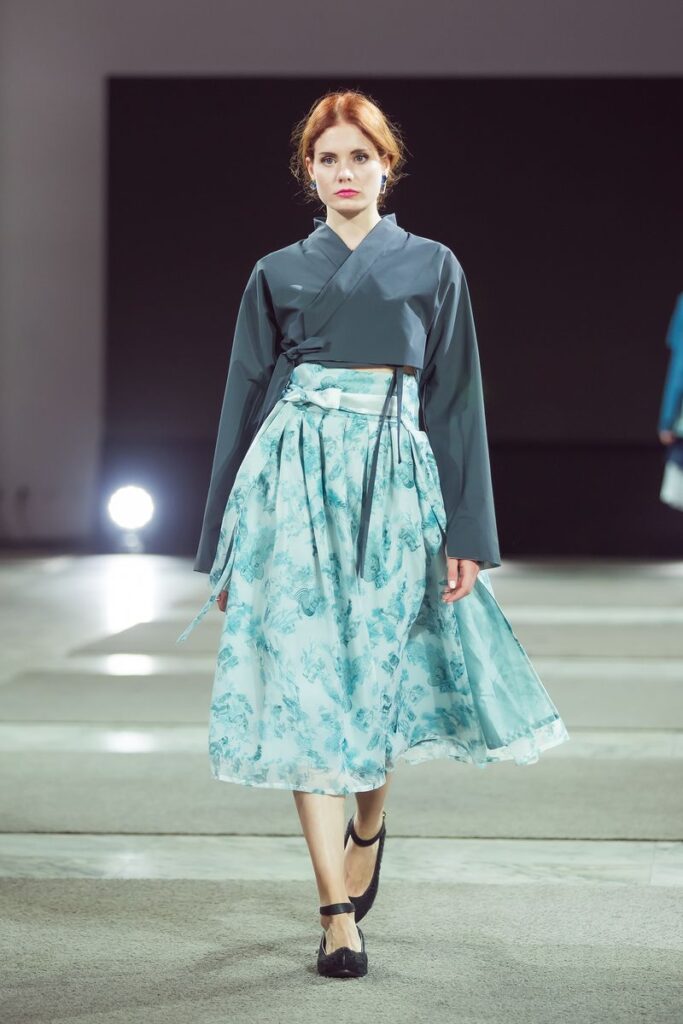
패션 디자이너에게 꿈의 무대인 파리패션위크에서 한복을 선보일 수 있어서 정말 기뻤습니다. 2019년 ‘밴쿠버패션위크’에 참가한 후 팬데믹이 터지는 바람에 해외 무대에 다시 서는 데 3년이 걸렸네요. 단순한 한복 쇼가 아니라 패션 브랜드의 쇼로 관객에게 가닿길 바랐어요. 그래서 기존 한복에서 잘 사용하지 않는 색감을 쓰고, 소재도 바꾸면서 고루하거나 고전적인 느낌에서 탈피해 신선한 스타일의 한복으로 인식하도록 노력했는데요. 현장에서의 반응이 좋았고, 현지 매체에서도 호감 어린 기사를 많이 보도해서 뜻깊었습니다.
I was really happy to show hanbok at Paris Fashion Week, a dream stage for any fashion designer. After participating in Vancouver Fashion Week in 2019, the pandemic broke out, so it took me three years to return to an overseas stage. I wanted to reach out to the audience with a fashion brand show, not just a hanbok show. That’s why I tried to use colors that are not often used with existing hanbok and change the materials that went into them in order to have my hanbok recognized as something that featured a fresh take on hanbok style, breaking away from the usual outdated or classical impression stereotype that is attached to it. The immediate response was really good in Paris, with a lot of local media outlets reporting quite favorably on it.
Q2.
쇼의 주제였던 ‘초월’은 단하주단의 지향점과 맞닿아 있는 것 같아요. 2020년 블랙핑크의 ‘How You Like That’ 뮤직비디오가 공개됐을 때 멤버들이 입은 단하주단 한복에 대한 반응이 정말 뜨거웠죠. 이제는 한복의 영역이 좀 넓어졌다고 생각하시나요?
Q2.
The theme of the show, transcendence, seems to be in line with the goal of Maison Danha. When BLACKPINK’s “How You Like That” music video was released in 2020, a lot of music fans seemed to have a really great response to Maison Danha’s hanbok worn by the group members. Do you think hanbok has gained a wider audience today?
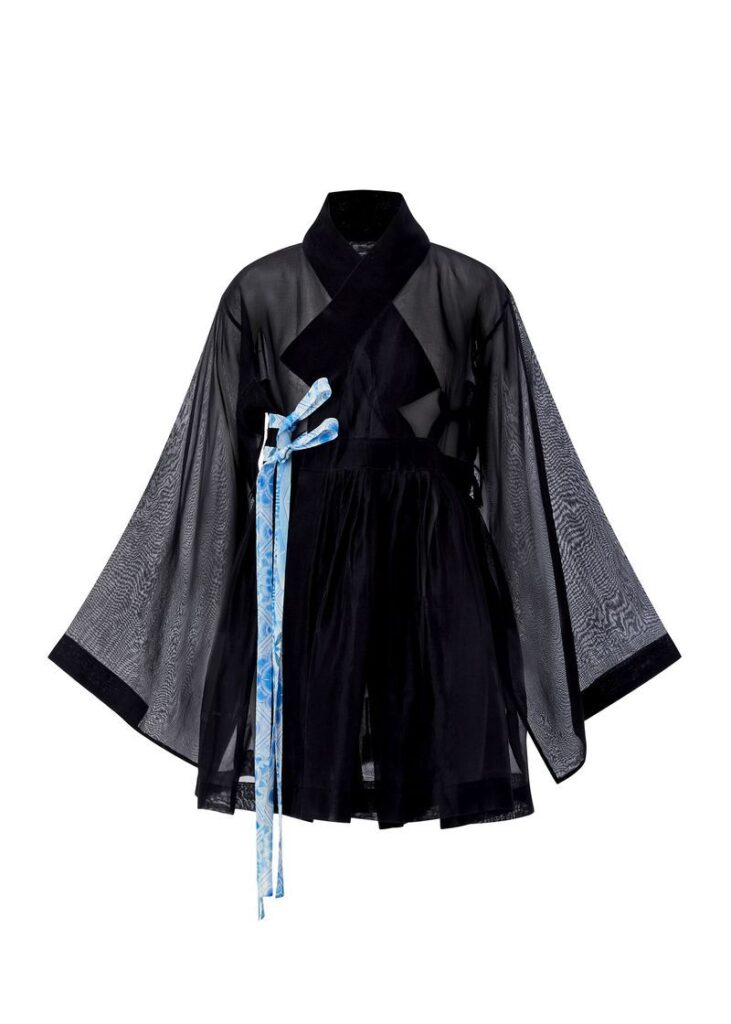
요즘 패션 브랜드는 성별 구분 없이 유니섹스 스타일이 흔한데요. 한복에서는 그런 시도를 하면 안 된다는 인식이 있었던 것 같아요. 근데 블랙핑크의 제니 씨와 로제 씨가 입었던 의상은 사실 남자의 전통 복식인 도포 1)와 철릭 2)을 재해석한 의상입니다. 경계를 허물고 싶어서 그런 작업을 계속하다 보니 이제는 어느 정도 한복의 영역이 넓어졌다는 생각이 들어요. 결혼식의 2부 드레스나 해외 여행지에서 입을 용도로 단하주단의 한복을 찾는 분들도 많고요. 확실히 한복에 대한 니즈가 다양해지는 걸 느낍니다.
Unisex styles are common with fashion brands these days. I think there was a perception that you shouldn’t try that in hanbok. The outfits worn by BLACKPINK’s Jennie and Rosé were actually made by reinterpreting men’s traditional clothing, the dopo 1)and the cheolic 2). As I kept making such attempts to break down boundaries, I think the scope of what a hanbok is has expanded to some extent. There are many people who are looking for a hanbok from Maison Danha to wear at their wedding party or when traveling overseas. I definitely feel that the needs for hanbok are becoming more diverse.
Q3.
단하 님은 한복의 어떤 매력에 빠져 디자인을 시작하게 되셨나요?
Q3.
What kind charm particular to hanbok did you fall in love with to make you want to start designing hanbok?
할아버지가 매듭 장인이셨어요. 어릴 때 할아버지 댁에 가면 큰 매듭이나 여러 작품을 보았던 기억이 납니다. 그리고 제가 다닌 고등학교 교복이 한복이었기 때문에 친숙하고 편안한 느낌이 있었죠. 어린 시절과 학창 시절의 환경이 영향을 미친 것 같아요. 한복을 워낙 좋아해서 해외여행을 다닐 때마다 원하는 한복을 주문 제작해서 입었어요. 원단이나 디자인 등 구체적으로 원하는 부분이 점차 늘어나는 상황이 오니까 아예 직접 만들어보자는 생각이 들었어요. 그래서 한국궁중복식연구원에서 2년간 한복 만드는 법을 배웠습니다. 손기술만으로는 부족하다는 생각에 제대로 한복의 뿌리를 알고 싶어서 의상학과 석사 과정에 진학해 복식사를 공부하게 되었어요.
My grandfather was a master of Korean traditional knot crafts. When I used to go to my grandfather’s house as a kid, I remember seeing big knots and various craftworks all around. And because the high school I went to required a hanbok as part of its uniform, I felt comfortable wearing a hanbok from an early age. As a result, I think my childhood and school environment had a big influence on me. I loved hanbok so much that whenever I traveled to another country, I wore a customized hanbok. Since the specific parts I really wanted to change, such as fabric and design, gradually increased over time, I began thinking I should make them myself. Eventually, I learned how to make hanbok at the Korean Royal Costume Research Institute over a period of two years. However, I felt that my skills as a hanbok seamstress were insufficient on their own, and wanted to know more about the roots behind hanbok. Thus, I took a master’s degree in fashion design and studied the history of costumes.
Q4.
복식사를 공부하신 영향일까요? 유물에서 모티프를 가져온 문양이 돋보이는데요. 단하주단에서 추구하는 패턴의 특징은 무엇인가요?
Q4.
It seems that because you completed a degree in the history of costumes, your patterns featuring motifs from relics stand out. What are some of the characteristics of the patterns pursued by Maison Danha?
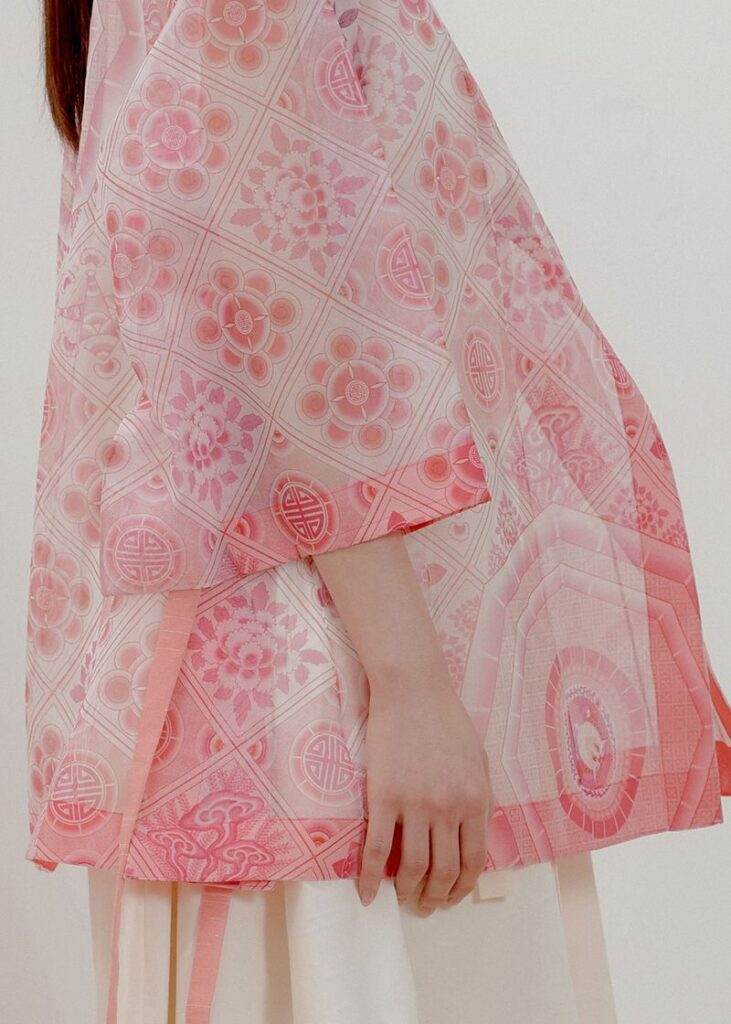
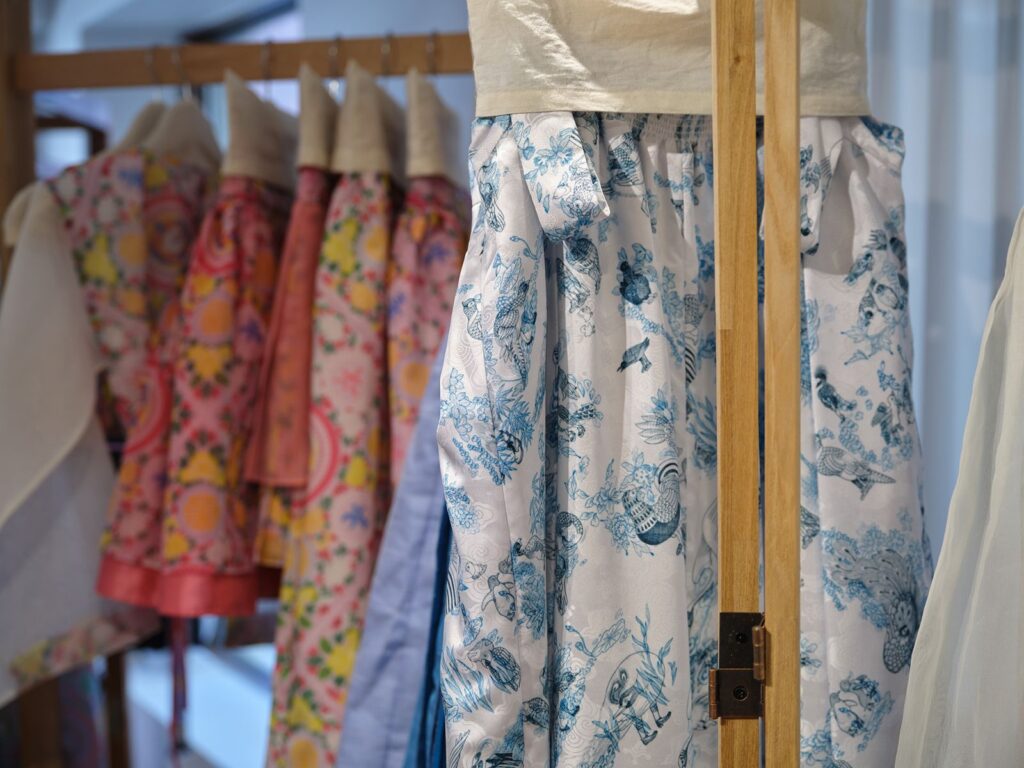
학업과 디자인을 병행한 게 확실히 큰 도움이 된 것 같아요. 많은 논문 자료를 찾아보면서 제가 알지 못했던 세계에 눈을 뜨게 됐죠. 특히 유물의 문양에 대한 설명을 논리적으로 잘 정리한 논문을 보면서 문양에 관한 관심이 깊어졌어요. 제가 한복 디자인에 활용하는 다양한 문양은 모두 궁중 도배지와 궁중 보자기의 문양입니다. 유물의 문양을 디지털라이징한 후 더욱더 돋보이도록 디자인을 가미하고 색을 입혀요. 컬러나 소재를 현대적으로 사용하기 때문에 문양으로 전통성을 표현하려고 노력 중이죠.
I think both studying and designing at the same time helped me a lot. I had my eyes opened to a world I hadn’t known beforehand by reading a lot of major papers and going over a ton of reference materials. In particular, I became interested in patterns after reading many papers that logically summarized the descriptions of patterns from relics. The diverse patterns that I use in hanbok design are all patterns from wallpaper and wrapping cloth used in the royal court. After digitalizing the patterns from the artifacts, we add the design and colors to further highlight the patterns. Since we use contemporary colors and materials, I’m trying to highlight tradition through the shapes of patterns.
Q5.
전통 예술 분야에서 활약하는 아티스트와 교류하며 선보인 책가도와 화조도, 단청 문양도 신선했어요. 이런 창의적인 협업은 어떤 방식으로 이뤄지나요?
Q5.
The chaekgado, hwajodo, and dancheong patterns you presented by interacting with other artists who are active in the fields of traditional art were also really fresh. How do these creative collaborations work?
원작 소스를 바탕으로 컬러 테스트와 그러데이션 등 다양한 시도를 하고 의견을 주고받는 과정을 거쳐 발전시킵니다. 민화 작업을 하는 이전경 작가님의 책가도와 화조도 패턴을 적용해 한복을 만들었을 때는 실제 원단이 원작과 분명 다른 느낌이면서, 기대했던 것보다 더 예뻤어요. 단청장 최문정 작가님의 단청 문양은 마고자 3) 패딩 재킷과 배자 4) 등 다양한 옷에 적용했고요. 협업한 작가님들과 만족스러운 결과물을 함께 만들 때면 제가 진짜 하고 싶었던 일을 하고 있다는 느낌을 받습니다. 앞으로 협업 영역이 더 넓어질 것 같아요. 지난겨울에는 한 모바일 게임의 한복 코스튬을 디자인했는데요. 실제 존재하는 의상이 아니라 가상의 3D 비주얼로 구현하는 과정이 재미있었어요. 더 나아가 드라마와 웹소설, 웹툰 등 다양한 콘텐츠와 협업해 한복을 선보일 예정입니다.
Based on the original source, a number of different attempts (such as color testing and gradation) are made, and designs are developed through the process of exchanging opinions. When I began making hanbok by applying the patterns from chaekgado and hwajodo by Lee Jeongyeong, a notable folk painter, the fabrics were clearly different from the original sources, and were actually prettier than expected. Choi Moonjung’s dancheong pattern was applied to various types of clothes, such as a magoja 3) padded jacket and a baeja 4). When I end up with satisfactory results with the artists I collaborate with, I feel I’m doing what I was truly meant to do. I think the scope of collaboration will be much broader in the future. In fact, last winter I designed hanbok costumes for a mobile game. The process of implementing them with a virtual 3D visual, not actual outfits, was interesting. Furthermore, we will also offer hanbok in collaboration with a wide range of content, such as dramas, web novels, and webtoons.
Q6.
단하주단의 한복에는 ‘전통’과 ‘현대’라는 수식어가 동시에 따라다녀요. 두 가지를 조화롭게 융합하기 위해서는 창의성만큼이나 균형감이 필요해 보입니다. 전통적인 요소로 문양을 활용한 것처럼 새로운 시도 중에도 계속 지키려고 노력하는 지점이 궁금합니다.
Q6.
It feels as if the modifiers “traditional” and “modern” follow all the hanbok designed at Maison Danha. To combine the two in harmony, a sense of balance—as much as creativity—seems to be necessary. What do you keep trying to maintain even while making new attempts, like when you use patterns as a traditional element?
무엇보다 본질에 집중하려고 해요. 컬러나 소재를 바꾸더라도 재단법은 전통 방식을 고수해 ‘한국의 복식’이라는 정체성을 담아냅니다. 평면 재단으로 만드는 한복은 몸에 딱 붙지 않고 핏이 약간 뜨는 부분이 참 멋스러워요. 그런 디테일에서 한국적인 부분이 묻어나기 때문에 가능한 한 평면 재단을 고수하려고 합니다. 게다가 평면 재단은 원단 유실량이 적고 자투리 원단이 생겨도 사각형이라서 재활용하기 쉬워요. 물론 그만큼 옷 만들기는 더 어렵지만, 사람의 손기술에 따라 다른 모양이 나올 수 있어요. 그래서 저는 한복을 ‘융통성 있는 옷’이라고 이야기합니다.
Above all else, I try to focus on the essence. Even if we change the colors or materials of a hanbok, we stick to the traditional cutting method and do our best to capture the identity of Korean clothing. Hanbok made through flat cutting doesn’t stick to the wearer’s body and has a slightly floating fit to it. This makes it look stylish. I try to stay with the flat cutting method as much as possible because the true Korean style is revealed in such details. In addition, flat cutting makes it easy to recycle fabric because it entails such a small amount of fabric loss. Even if there are spare pieces of fabric, they’re rectangular, making it easy to recycle. Of course, it’s more difficult to make clothes in that way, but different shapes can emerge depending on how a person uses their hands. That’s why I call hanbok “flexible clothing.”
Q7.
브랜드를 론칭할 때부터 ‘전통에 기반한 지속가능성’을 강조하셨어요. 지속가능한 한복에서 가장 중요한 점은 무엇일까요?
Q7.
You have emphasized “sustainability based on tradition” since you launched your brand. What is the most important thing about sustainable hanbok?
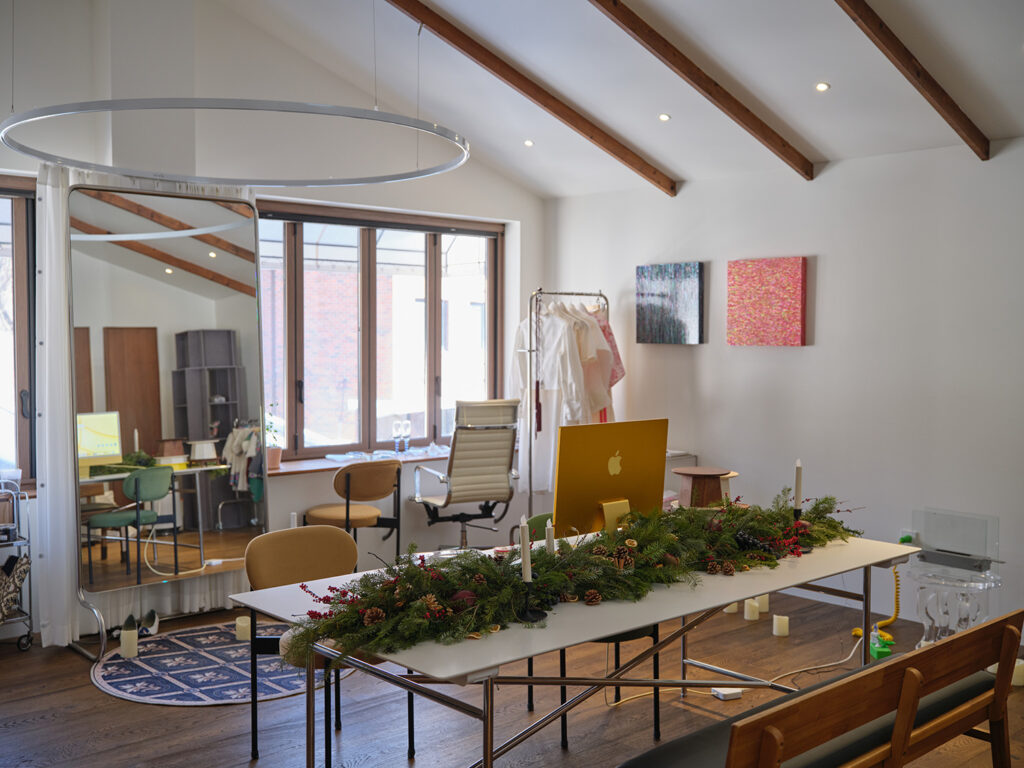
의무감이 아니라 일상에서 자연스럽게 입고 즐기는 옷으로 한복이 계속 회자된다면 전통은 더 이상 전통이 아닐 겁니다. 전통이 지속가능하기 위해서는 그렇게 되어야 한다고 믿어요. 그동안 장롱 속 옷으로 인식하던 한복이 이제 세상으로 나와서 새로운 역사를 만들어가고 있습니다. 한복 디자인은 역사적으로 계속 바뀌었는데 지금도 변화를 겪고 있어요. 이 시대의 한국인이 지금 이런 스타일의 한복을 입는다는 점에서 지속가능성을 말할 수 있을 거예요.
Tradition will no longer be tradition if hanbok is seen as something that can be worn and enjoyed naturally in people’s everyday lives, not something they wear due to a sense of obligation. I believe that hanbok need to be considered in the former way in order to make tradition sustainable. Hanbok, which used to be seen as clothing you kept in the closet, are now coming out into the world and writing a new chapter in history. The truth is that [HR1] hanbok design has changed throughout the ages, and is still undergoing changes. Also, we can mention sustainability in that Koreans today are now wearing this style of hanbok.
Q8.
지속가능성에서 친환경을 빼놓을 수 없는데요. 실제 환경친화적 방법으로 한복을 만드는 일에 관심이 많으세요. 구체적으로 여쭤봐도 될까요?
Q8.
Eco-friendliness is essential for sustainability. From what I gather, you are interested in making hanbok in an eco-friendly way. Could you tell us more about this?
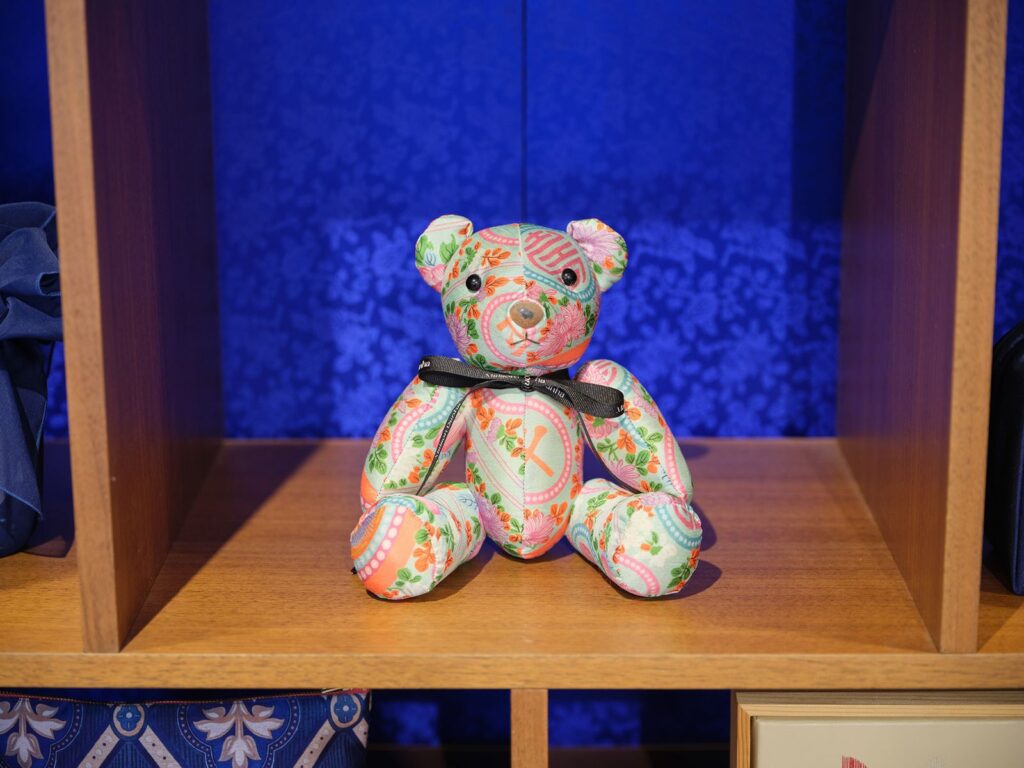
브랜드를 론칭할 당시, 미세먼지 문제가 굉장히 심각했어요. 옷 만드는 사람이 되겠다고 결심했을 때부터 의류 폐기물을 외면할 수 없었고, 자연히 업사이클링과 리사이클링에 관심을 두게 되었습니다. 폐페트병으로 만든 소재로 한복을 지어봤는데 예상보다 감촉이 부드럽고 좋았어요. 유기농 면과 함께 사용하기도 하고요. 처음에는 친환경 소재 사용률이 50%가 채 되지 않았지만, 지금은 60~70% 정도까지 비율을 높였습니다. 또 버려지는 중고 한복을 활용해 패브릭 노리개를 만들고, 패션쇼에서는 협업을 통해 폐간판의 아크릴을 재활용한 노리개와 이어링을 선보였어요. 장신구 외에도 오브제 등 여러 분야의 업사이클링 아티스트와 친환경 철학을 공유하며 협업 중입니다.
When I was launching my brand, the fine dust problem in Korea was very serious. Since becoming a clothing maker, I haven’t been able to turn a blind eye to clothing waste, and I have naturally become interested in upcycling and recycling. I tried making hanbok with materials made of waste PET bottles, and they actually turned out feeling softer than expected. We also used these materials together with organic cotton. At first, the utilization rate of eco-friendly materials was less than 50 percent, but now we have increased it to 60 to 70 percent. In addition, we adapted parts of formerly used hanbok to make fabric norigae (Korean traditional ornaments worn by women), with one of our fashion shows featuring norigae and earrings that had recycled acrylics from waste signboards through a collaboration with other businesses. Besides accessories, we are collaborating with upcycling artists in myriad fields, including objects, while sharing our eco-friendly philosophy.
Q9.
지난 2022년은 세계적인 주목을 받으며 해외 무대에서도 활발히 활약했던 한 해였습니다. 오는 2023년 새해 계획과 앞으로의 방향성이 궁금합니다.
Q9.
In 2022, you received international attention and were quite active on overseas stages. I’m curious about your plans for 2023 and where you see yourself headed.
새해에는 유럽에 플래그십 스토어 오픈을 준비 중이에요. 런던이 유력한 상황이고, 빠르면 오는 6월쯤에 문을 열 수 있을 것 같습니다. 해외 패션박람회에 참여하고, 미국 시장에도 진출할 계획이고요. 한복에 대한 고정관념을 깨고 싶다는 열망으로 단하주단을 시작한 만큼, 한복이 평소 입는 패션 아이템으로 자리 잡을 수 있도록 계속 노력하겠습니다.
We are preparing to open a flagship store in Europe in the new year. London is the most likely location, and I think it will be open in June at the earliest. At the same time, we’re planning to participate in overseas fashion fairs and enter the U.S. market. As I started Maison Danha with a desire to break the stereotypes associated with hanbok, I will continue to work hard to make hanbok a fashion item that we can wear in our everyday lives.
1) 조선시대 선비가 평상시에 입던 겉옷.
2) 조선시대 무관이 입던 업무복. 상의와 주름 잡힌 치마를 따로 만들어 허리 부분을 연결한 점이 특징이다.
3) 저고리 위에 덧입는 웃옷.
4) 저고리 위에 덧입는 짧은 조끼 모양의 옷.
1) A hanbok overcoat worn by noblemen in the Joseon Dynasty.
2) A military uniform from the Joseon Dynasty. It is characterized by the fact that a top and wrinkled skirt were separately designed and then connected in the waist.
3) A type of jacket worn on top of the jeogori (short jacket).
4) A type of short vest which is worn over the jeogori.