Extraordinary
기아 디자인 크리에이티브 철학 ‘오퍼짓 유나이티드 (Opposites United)’에서 제시하는 창의적 문화의 특징으로 ‘창의적 모험가 Creative Risk-Takers’와 ‘지치지 않는 혁신가 Relentless Innovators’가 있습니다. 이들은 새로운 가능성을 위한 끊임없는 도전으로 자신만의 고유성과 창의성을 바탕으로 창작활동을 하는아티스트들의 스토리에서 찾아볼 수 있습니다.
Extraordinary
Kia Design’s creative philosophy, ‘Opposites United’, characterizes the creative culture of Creative Risk-Takers and Relentless Innovators. This is demonstrated in the stories of the artists, who constantly challenge themselves to create new possibilities by building on their unique perspectives and creativity.
오래된 언어, 한지로 새로운 문장을 엮다
섬유 아티스트 고소미Weaving New Sentences with Hanji, an Ancient Material
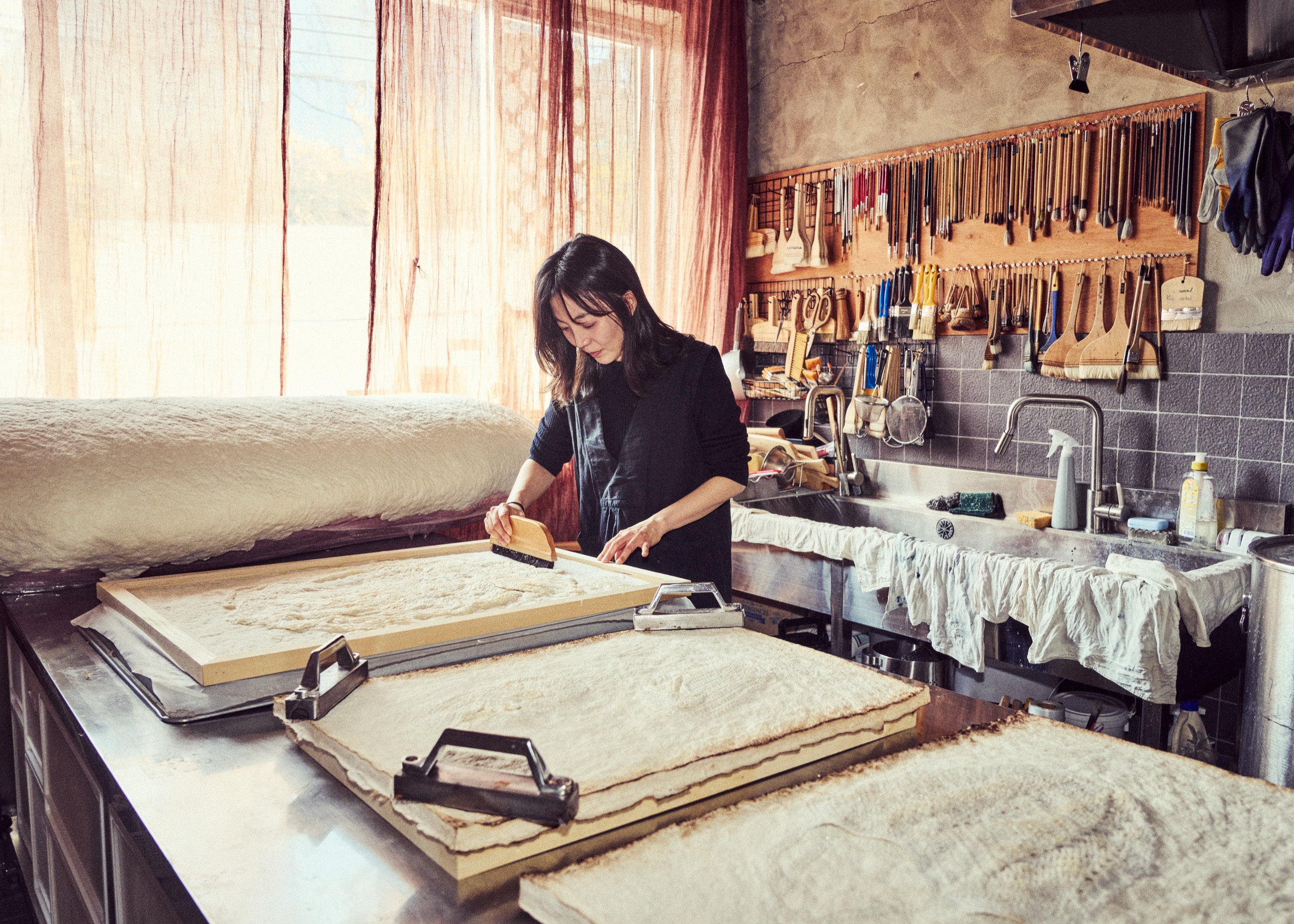
Ko Somi, Hanji Textile Artist손끝으로 꼬고 또 꼬아 한 올이 완성되는 순간, 종이는 실이 되고 기억은 형태를 얻습니다. 단순한 물성의 변형이 아니라, 흔적이 언어가 되는 일입니다. 고소미는 그 과정을 20년 넘게 이어오며, 가장 오래된 한지라는 재료로 지금 이 시대의 질문을 엮어냅니다. 무엇을 기억할 것인가, 무엇을 남기고 이어갈 것인가, 그리고 무엇을 새롭게 만들어낼 것인가. 그녀에게 헤리티지는 박물관의 언어가 아니라 손끝에서 날마다 다시 태어나는, 살아 있는 문장입니다. 《기아 디자인 매거진》 Vol.17 Extraordinary는 오래된 재료인 한지 위에 동시대의 새로운 문장을 엮어가는 고소미의 작업 세계를 따라갑니다.
Ko Somi twists Hanji (Korean traditional paper) over and over with her fingertips, spinning it into thread, weaving new memories. Her work is not merely a physical transformation but an act of translating the traces of time into a new language. Ko Somi has been doing this for over 20 years, weaving the questions of our time with Hanji, one of Korea’s oldest handmade materials. Somi’s work asks what we choose to remember, what we carry forward, and what we remake for the present. To her, heritage is not a museum-bound language, but a living sentence reborn each day at her fingertips. In this issue, we follow Ko Somi’s creative world as she weaves new contemporary sentences from the ancient material of Hanji.
Editor’s Note
“500년 뒤에는 지금이 다시 헤리티지가 될 수 있어요.” 한지 위에서 형태를 여러 번 무너뜨리고 다시 쌓아 올리던 고소미 작가는 말합니다. 헤리티지는 보통 과거의 것으로 이해됩니다. 그러나 그녀의 말을 듣는 순간, 시선은 자연스럽게 현재로 이동합니다. 지금 이 순간이 이미 헤리티지라는 뜻이 아니라, 미래의 시점에서 돌아보았을 때 그 시간이 어떻게 남게 될 것인가에 대한 질문이기 때문입니다. 전통을 잇는다는 일은 과거를 반복하는 것이 아니라, 지금을 어떻게 만들어가느냐에 대한 선택에 가깝습니다. 한지라는 오래된 재료 안에서 끊임없이 방식을 의심하고, 형태를 다시 만들며, 스스로의 기준을 갱신해온 고소미 작가의 작업은 그 질문에 대한 하나의 답처럼 보입니다. 《기아 디자인 매거진》 Vol.17 Extraordinary는 그 태도를 손끝으로 실천해온 과정을 따라갑니다.
“In 500 years, what we do today could become part of our heritage,” says artist Ko Somi, who repeatedly dismantles and rebuilds forms using Hanji. Heritage is commonly understood as something belonging to the past. Yet the moment you hear her words, your gaze naturally shifts to the present. This is not to say that this very moment is already heritage, but rather that it poses a question about how this time will be remembered when viewed from the future. Carrying on tradition is not about repeating the past; it is, above all, a choice about how we shape the present. Artist Ko Somi’s work—in which she constantly questions methods, reshapes forms, and renews her own standards within the ancient medium of Hanji—appears to be an answer to that question. In Kia Design Magazine Vol. 17 Extraordinary, we follow the process through which she has put that perspective into practice with her own hands.
Chapter 01.
종이를 연구한다는 것, 전통을 잇는다는 것
Chapter 01.
Understanding Hanji, Rethinking Tradition
재료를 이해하는 일은 그 안에 쌓인 시간을 읽는 일입니다. 고소미는 20년 넘게 한지를 연구해오며, 그것이 단순한 종이가 아님을 알게 되었습니다. 장인의 손, 땅의 풍토, 수백 년의 쓰임이 한 장의 종이 안에 담겨 있기 때문이죠.
Understanding a material means reading the time accumulated within it.
Having studied Hanji for over 20 years, Ko Somi has come to realize that it is much more than just a type of paper.
A single sheet of Hanji holds the hands of artisans, the temperament of the land, and centuries of use.
20년 넘게 한지를 연구하고 작업해오면서, ‘헤리티지’라는 개념을 어떻게 받아들였는지 궁금합니다.
고정된 유물이 아니라, 현재의 시간 속에서 끊임없이 재구성되는 ‘생성적 흔적’이라고 생각해요. 과거의 형태를 그대로 복제하는 것이 아니라, 그 안에 쌓인 시간의 결을 읽고 지금의 언어로 다시 쓰는 것, 그것이 제가 정의하는 헤리티지입니다. 근본은 분명히 존재하지만, 그것을 그대로 가져오는 일은 어쩌면 억지스러운 행위일 수 있습니다. 한지 역시 처음에는 글과 그림을 기록하는 재료였지만, 지금은 그 쓰임 자체가 점차 사라지고 있잖아요. 그렇다면 한지도 지금에 맞는 새로운 언어를 찾아야 한다고 생각합니다. 헤리티지는 옛 정신을 바탕으로 지금에 맞게 변화해야 하며, 500년 뒤에는 지금이 다시 헤리티지가 되지 않을까요.
How has your understanding of the concept of ‘heritage’ evolved as you have researched and worked with Hanji over the past 20 years?
I see it not as a static artifact, but as a ‘generative trace’ that is constantly being reconfigured within the present moment. It is not about replicating the forms of the past exactly, but about reading the texture of time accumulated within them and rewriting them in a contemporary language. While the roots certainly exist, carrying them over unchanged can feel forced. Hanji, too, was once a material for recording text and image, but those traditional uses are slowly fading. Therefore, I believe Hanji must find a new ‘language’ suited to the present. Heritage must evolve with the present while remaining rooted in the spirit of the past. Perhaps 500 years from now, the present itself will become heritage.
한지를 통해 오랜 시간 전통을 이어오셨는데, 처음 한지를 선택하게 된 계기는 무엇인가요?
동양화를 전공하던 시절부터 눈에 보이지 않지만 존재하는 것들을 그리고 싶었어요. 바람이 첫 번째 주제였는데, 바람을 그린다는 게 쉽지 않잖아요. 그림이 공중에 떠 있는 듯한 느낌을 내려면 가볍고 반투명하면서도 단단한 재료가 필요했는데, 한지가 바로 그런 재료였어요. 그렇게 물성 연구가 시작됐고, 제가 의도한 것 이상을 종이가 받아준다는 느낌, 그것이 한지의 가장 큰 매력이라고 생각해요.
한지를 깊이 연구하기 위해 해외로 나가셨다고요. 그 과정과 지금까지 영향을 준 배움이 궁금합니다.
당시 한국에는 한지를 전문적으로 연구할 수 있는 환경이 충분하지 않았어요. 그래서 자연스럽게 해외로 시야를 넓히게 됐고, 그 과정에서 재료를 깊이 있게 다룰 수 있는 곳을 찾아가게 됐습니다. 처음에는 작업의 방향과 맞지 않는 부분도 있었지만, 한지를 본격적으로 연구하던 스승을 만나면서 방향이 분명해졌어요. 닥섬유를 중심으로 한지의 구조와 물성을 탐구하며 재료에 대한 이해를 쌓아갔습니다.
그 과정에서 가장 크게 남은 가르침은, 작업이 단순한 자기 표현에 머무르지 않기 위해서는 철학적인 기반이 필요하다는 것이었습니다. 작품을 보는 사람들이 무엇을 느끼게 될지, 그리고 그 작업이 어떻게 완성될지에 대한 책임을 가져야 한다는 이야기였죠. 그래서 자연스럽게 철학 공부를 병행하게 되었고, 그 시간들이 지금 작업의 뼈대를 이루고 있습니다.
그 긴 연구의 시간이 결국 헤리티지를 이해하는 과정이기도 했겠네요.
재료를 이해하는 일과 헤리티지를 이해하는 일은 저에게 결국 같은 방향을 향하고 있어요. 한지를 꽉 쥐었다 놓았을 때 남는 구김은 물리적 변형을 넘어, 그 사물이 세계와 부딪히며 남긴 정직한 생존의 기록이자 흔적이에요. 그래서 저는 재료 안에 이미 헤리티지가 담겨 있다고 생각합니다.
Hanji is regarded as part of Korean cultural heritage. What led you to choose Hanji in the first place?
As an East Asian painting major in college, I wanted to depict things that existed but were not visible. Wind was my first subject, but depicting something invisible is never simple. To create the feeling that a painting is floating in the air, I needed a material that was light, translucent, yet sturdy, and Hanji was exactly that. That was the beginning of my research into the material properties of Hanji.
I felt that Hanji allowed me to express my intention beyond my expectations, which is its greatest merit.
I understand that you went abroad to explore Hanji more deeply. Could you tell us about that journey, and the lessons that have continued to shape your work?
At the time, South Korea did not have institutions for specialized research on Hanji. So, I looked for suitable institutions overseas and ended up at an institute which had a strong focus on material properties research. I struggled to align my study with the direction of my work, but I met a mentor who was deeply engaged in researching Hanji, which clarified my path. I built my understanding of the material by exploring the structure and physical properties of Hanji made from paper mulberry fibers.
The most significant lesson I took away from my study was that a philosophical foundation is required for my work to transcend mere self-expression. In other words, I need to take responsibility for what viewers would feel when encountering my work and for how that work would be realized. So, I have studied philosophy alongside my art, and those years now form the foundation of my current work.
It seems like your research years have helped you understand the concept of heritage as well.
For me, understanding materials and understanding heritage ultimately point in the same direction. The creases that form when I clench Hanji tightly and release it are not merely physical deformation; they are honest records and traces of survival left behind as the material meets the world. That is why I believe heritage is already embedded within the material itself.
Chapter 02.
흔적을 담은 실, 소미사
Chapter 02.
SOMISA, Threads That Carry Traces
버려진 종이는 끝나지 않습니다.
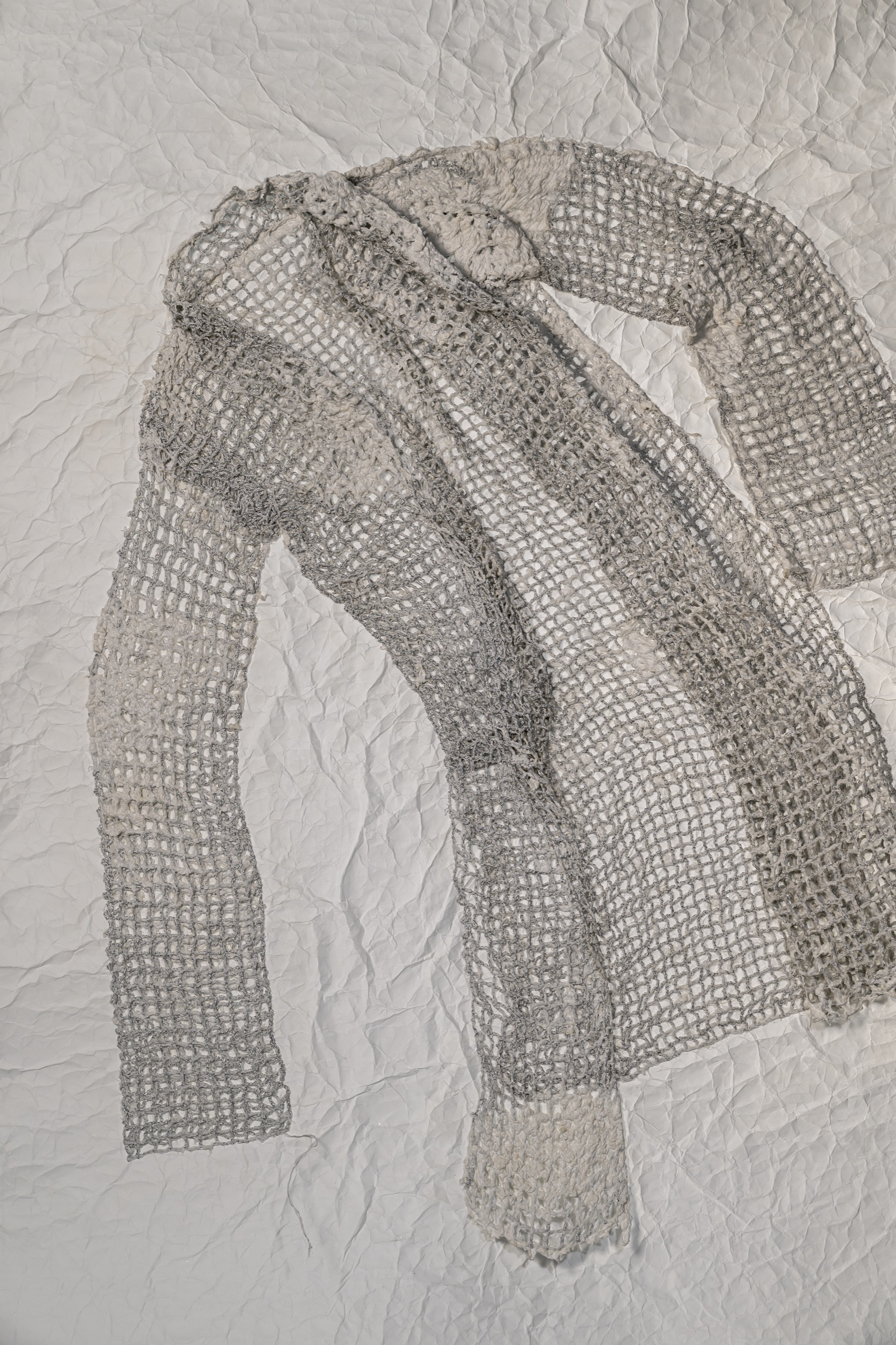
손을 거쳐 다시 이어지고, 실이 되어 남습니다. 고소미의 작업은 사라질 것들을 다시 연결하는 데서 시작됩니다.Discarded paper does not simply vanish.
Passed through human hands, it is reconnected and remains as thread.
Ko Somi’s work begins by reconnecting things once destined to disappear.
작가님의 언어가 되고 있는 소미사가 탄생하게 된 계기가 궁금합니다.
일본 유학 시절 외로움을 달래려고 한지 위에 먹으로 그림을 많이 그렸어요. 그리운 사람을 기억으로 더듬어가며 퍼즐을 맞추듯 같은 얼굴을 반복해서 그렸죠. 시간이 지나니 파지가 셀 수 없이 쌓였어요. 버리기에는 아깝고, 보존하기도 어려운 그림들이었습니다. 그러던 어느 날 양모로 실을 만드는 수업을 듣다가 번뜩 떠올랐어요. ‘저 물레에 한지를 넣으면 실이 되지 않을까.’ 그게 시작이었습니다. 한 달이 넘도록 시도했지만, 계속 끊겼어요. 그래도 멈추지 않았습니다. 결국 되는 순간이 오리라는 것을 알고 있었기 때문입니다.
그림을 해체해서 실로 만든다는 것, 작가님에게는 어떤 의미였나요?
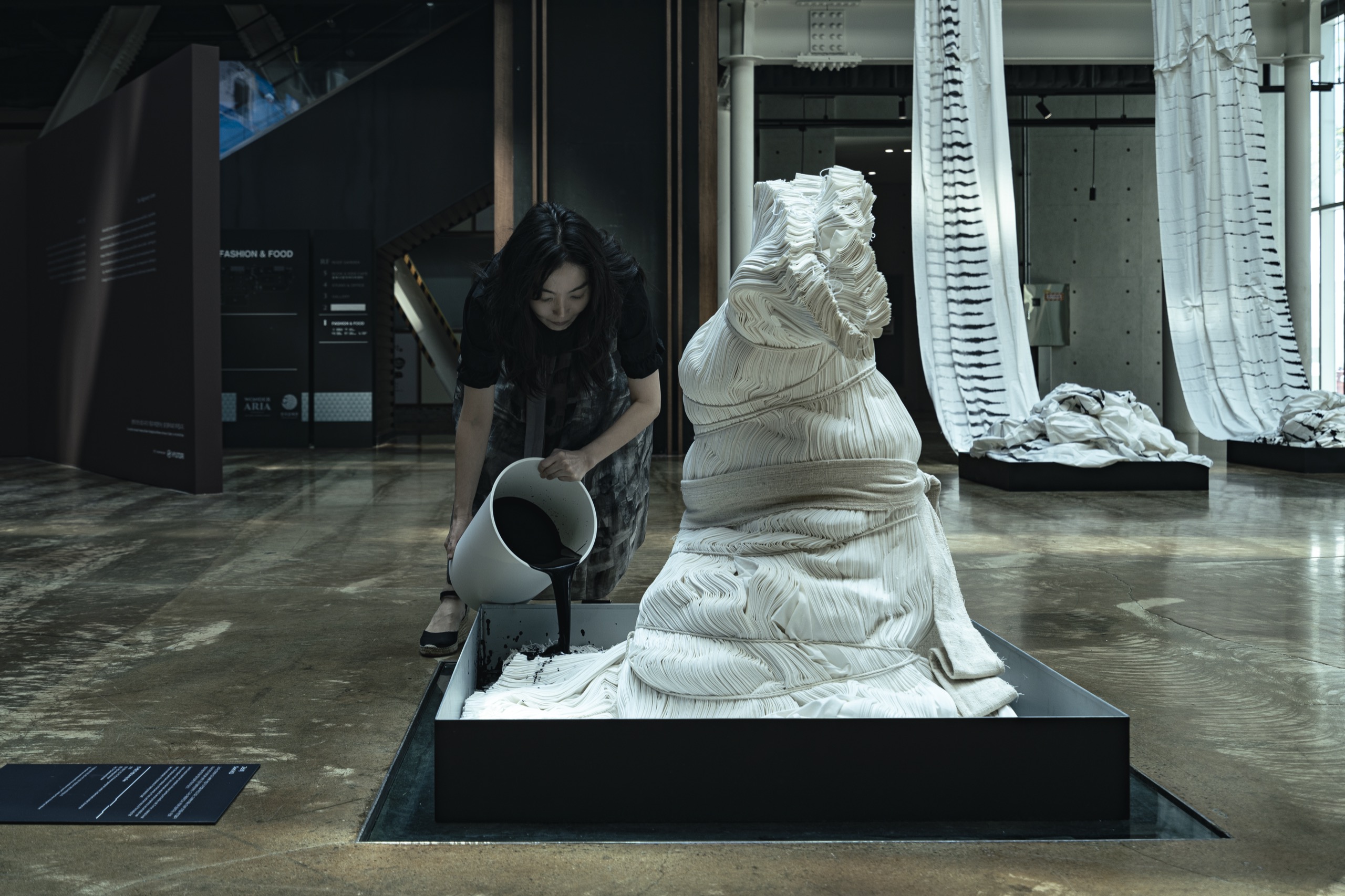
해체는 새로운 생성을 위한 준비였습니다. 기억 속을 유영하며 그린 그림들을 풀어내는 일이 상실을 극복하고 존재를 재구성하는 매개체가 됐죠. 실패한 그림이 사라지는 것이 아니라 다른 형태로 다시 태어나는 거예요. 그 안에 제 흔적이 그대로 남아 있는 채로요. 같은 사람을 떠올려도 오늘의 기억과 어제의 기억은 늘 조금씩 달랐습니다. 그러면서 깨달았습니다. 정답은 없다는 것을요. 그래서 이 모든 것들이 모여야 비로소 해석의 여지가 생긴다고 생각했습니다. 한 장만으로는 충분하지 않았던 거예요.
How did SOMISA, now central to your artistic language, first come into being?
While studying in Japan, I drew a lot with ink on Hanji to ease my loneliness. I traced the faces of people I missed, drawing the same face over and over as if piecing together a puzzle. I eventually ended up with many drawings that were too precious to throw away, yet too difficult to preserve. Then one day, while taking a class on making yarn from wool, it suddenly occurred to me. ‘What if I put Hanji into that spinning wheel? Wouldn’t it turn into thread?’ That was the beginning of my work on SOMISA, thread made of Hanji. The thread kept breaking, but I kept trying because I knew a moment of success would eventually come.
What did it mean to you, as a painter, to deconstruct your paintings and turn them into thread?
Deconstruction was a preparation for a new creation. The act of unraveling the paintings I created while drifting through my memories became a medium for overcoming loss and reconstructing my existence. It was not a process of making a failed painting disappear but rather enabling it to be reborn in a different form with my traces intact within it. Even when recalling the same person, each day the memories of the person were always slightly different. Through the experience, I realized that there is no single correct answer. I realized that the possibility of interpretation emerges only when all these elements come together. A single painting was simply not enough.
소미사는 어떻게 만들어지게 되었는지 궁금합니다.
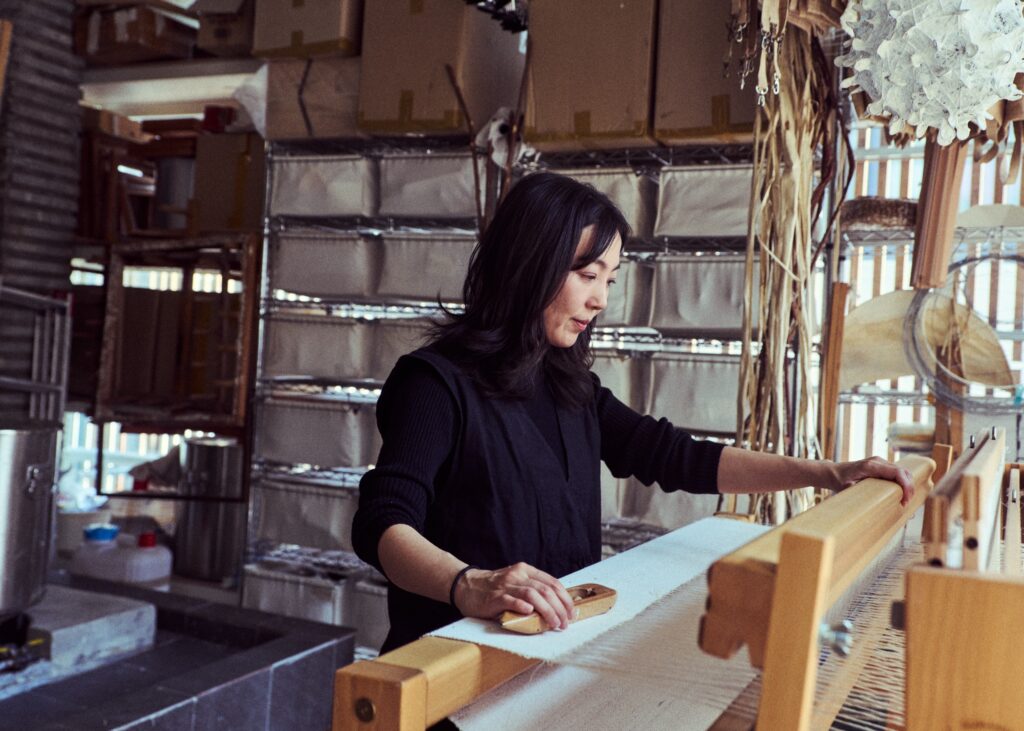
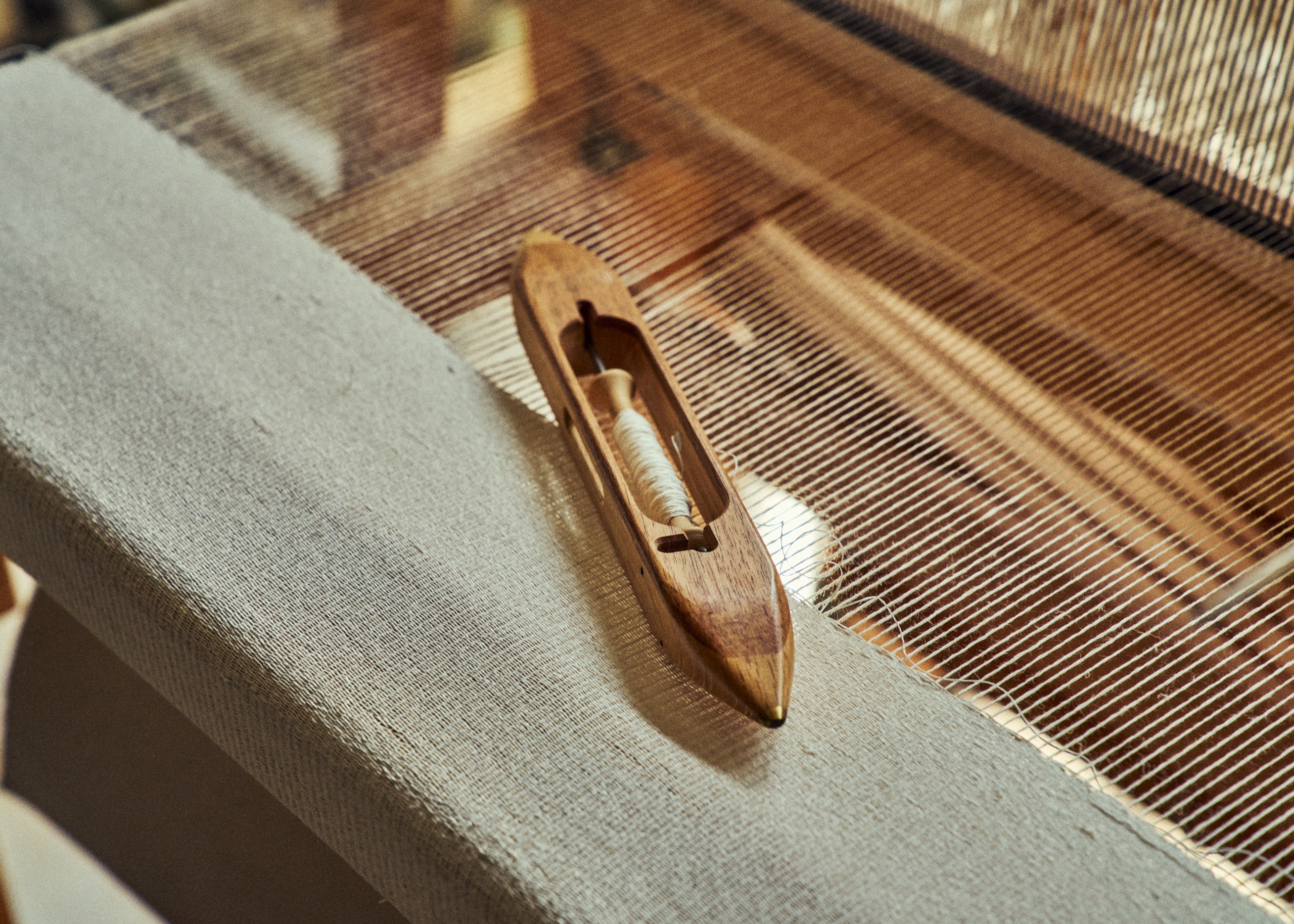
한지를 결대로 0.5센티미터 너비로 이어지도록 잘라 스피닝 기계에 넣고 꼬아주면 실이 만들어져요. 기계를 돌리는 속도를 조절하고, 풀이 섞인 물을 뿌려 수분을 공급해야 더 좋은 실이 만들어집니다. 처음에는 한 달 넘게 시도해도 계속 끊겼어요. 바퀴 속도와 종이의 장력이 맞아야 끊어지지 않는데, 그 텐션을 익히는 데 시간이 꽤 걸렸죠. 이제는 익숙해져 한 장을 기준으로 약 한 시간이면 실을 만들 수 있습니다.
Tell me about the process of making SOMISA?
I cut Hanji along the grain into long strips about 0.5 centimeters wide, then feed them into a spinning machine to twist them into thread. To make it stronger, I must adjust the machine’s speed and spray water mixed with glue. In the first month, the thread kept breaking. The wheel speed and the tension of the paper have to be just right for it not to break, and it took quite a while for me to get the tension just right. I can now make thread from a single sheet in about an hour.
한지를 결대로 자른다고 하셨는데, 그 결을 어떻게 파악하나요?
현미경으로 섬유를 들여다봤어요. 한지는 앞뒤, 좌우로 흔들어 뜨기 때문에 닥섬유가 ‘우물 정井’자 형태로 교차하며 배열됩니다. 반면 일본의 화지는 높이가 있는 틀 안에 닥섬유를 가두고 한 방향으로만 흔들어 뜨기 때문에 섬유가 일렬로 배열되죠. 그 차이를 발견하면서 깨달았습니다. 한 방향으로 배열된 섬유를 결대로 자르면, 꼬일 때 더 단단한 실이 만들어진다는 사실을요. 그래서 소미사를 만들 때는 화지처럼 ‘가둬 뜨기’ 방식으로 섬유가 한 방향으로 배열된 한지를 장인들께 특별히 주문해서 사용합니다. 강도 실험과 염색 테스트를 반복하며, 그 차이를 몸으로 익히는 데 5년 가까운 시간을 쏟은 것 같아요.
그렇다면 소미사가 꼭 한지여야 하나요?
꼭 한지가 아니어도 됩니다. 신문 기사를 읽다가 강한 감정이 일거나 기억이 떠오르면, 그 페이지들을 모아둡니다. 그걸 잘라서 실로 만들고, 제 방식대로 다시 재구성해보는 거예요. 저는 제 생각이 항상 옳다고 믿는 편은 아닙니다. 의견이 다른 누군가의 이야기를 들으면 왜 그런 생각을 하게 되었는지 그 배경을 먼저 찾게 됩니다. 그 사람의 흔적을 찾는 행위예요. 그래서 소미사는 한지만의 이야기가 아니라, 흔적을 담은 모든 종이의 이야기입니다.
‘소미사’라는 이름에 담긴 의미가 궁금합니다.
다나카 교수님께서 지어주셨어요. 제 글과 그림이 담긴 파지로 만들었다고 하니까 “보이지 않아도 이미 이 실에는 너의 흔적이 담겨 있다. 이것이야말로 진짜 너만의 실”이라고 하셨죠. 작은 소小, 매혹할 매魅, 실 사絲를 조합한 이름입니다. 魅가 일본어로 ‘ミ(미)’로 읽히면서 작가의 이름 ‘소미’와 자연스럽게 겹쳤어요. 작은 것들이 쌓여 누군가를 매혹하는 무언가를 만든다는 의미입니다. 소미사 뭉치를 마주하면 비로소 작업을 시작할 준비가 되었다는 마음이 들어요.
You said cutting Hanji along the grain. How do you identify that grain?
I examined the fibers of Hanji under a microscope. In traditional Hanji-making, the screen is moved in multiple directions, allowing paper mulberry fibers to interlock in a crisscross structure. By contrast, washi is made by moving the screen primarily in one direction, aligning the fibers along a single grain. Upon discovering this structural difference, I realized that stronger threads can be made using papers with fibers arranged in a single direction. This is why I specially commission artisans to manufacture Hanji with the fibers arranged in a single direction using the ‘enclosed papermaking’ method used to make Japanese washi. I think I spent nearly five years conducting strength tests and dyeing trials to fully grasp the properties of different paper materials.
Does SOMISA have to be made using Hanji?
It doesn’t have to be made from Hanji. For example, I save newspapers when I read a newspaper article that stirs strong emotions or brings back memories. I cut them up to make thread and then reconstruct them in my own way. I know that my perspective is never absolute. So when I meet someone with a different opinion, I try to learn about their background to understand what may have led them to think that way. It is a process of searching for that person’s traces. That’s why SOMISA isn’t just a story about Hanji but a story about all paper that holds traces.
What is the meaning behind the name “SOMISA”?
The name was given to me by my mentor, Professor Tanaka. When I told him it was made from paper containing my writings and drawings, he said, ‘Even though you can’t see it, this thread already bears your mark. This is truly a thread that belongs only to you.’ The name is a combination of the Chinese characters for “small” (小), “charm” (魅), and “thread” (絲). Since “魅” is read as ‘Mi’ in Japanese, it naturally overlapped with my name, ‘Somi.’ So, SOMISA means ‘small things that collectively create something that captivates others.’ When I have a bundle of SOMISA in front of me, I feel ready to begin working.
직접 실을 만드는 긴 시간이 작업에 어떤 영향을 주나요?
같은 작업을 반복하다 보면 스피닝 기계와 한지, 그리고 제가 하나로 이어지는 느낌을 받습니다. 잡생각이 사라지고 오롯이 현재의 감각에만 집중하게 되는 순간이요. 이 몰입의 끝에서 과거의 상처를 마주하고, 그것을 이해하고 용서하는 정신적 정화의 순간을 경험하기도 합니다. 저에게 소미사를 만드는 시간은 수련이자 명상이라고 할 수 있습니다.
How does the long process of making your own thread influence your work?
As I repeat the same process, I feel as though the spinning wheel, the Hanji, and I become one. It is a moment when distracting thoughts vanish, and I focus solely on the sensations of the present. At the end of this immersion, I sometimes experience a moment of spiritual purification, confronting past wounds, understanding them, and forgiving them. For me, the time spent making SOMISA is both a form of training and meditation.
Chapter 03.
조형에서 공간으로, 한지의 확장
Chapter 03.
From Form to Space: The Expansion of Hanji
흔적은 사람 안에만 존재하지 않습니다.
장소에도, 재료에도, 그리고 빛이 만들어내는 그림자에도 존재합니다. 고소미의 작업이 공간으로 확장된 것은 이 사실을 발견하면서부터였습니다.Traces do not just exist within people.
They exist in places, in materials, and even in the shadows created by light.
It was upon this realization that Ko Somi’s work began to expand into space.
한지 하면 흔히 떠올리는 게 공예인데, 설치 작업을 해오셨어요. 더욱이 조명 작업까지 하셨는데 특별한 계기가 있었나요?
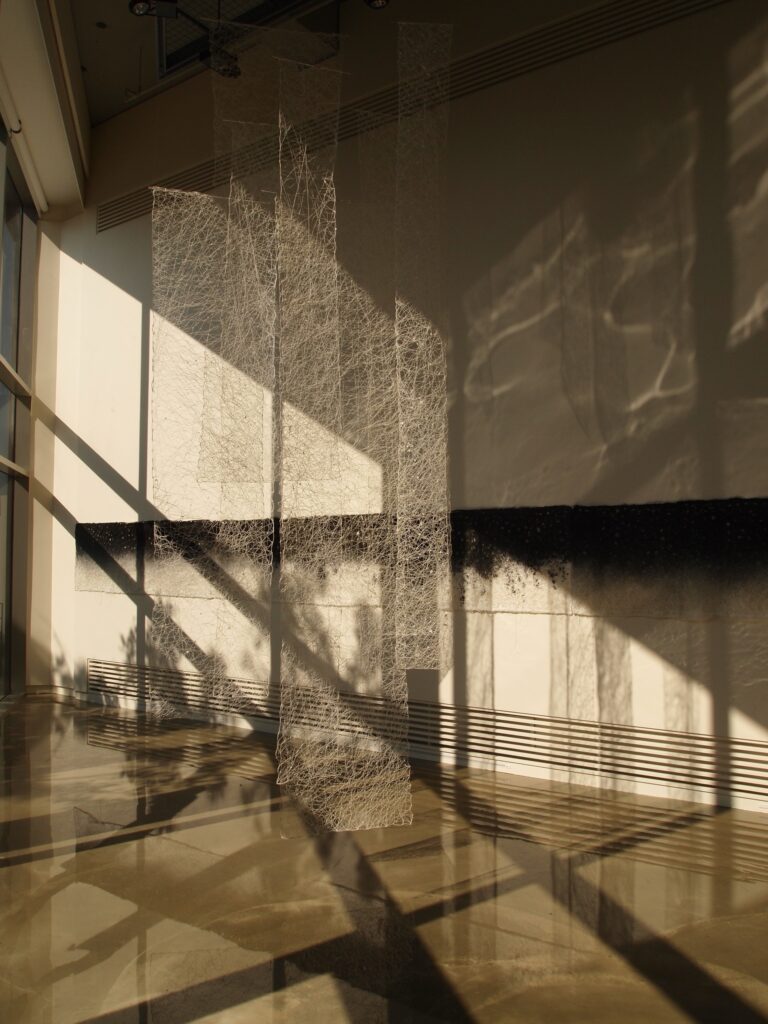
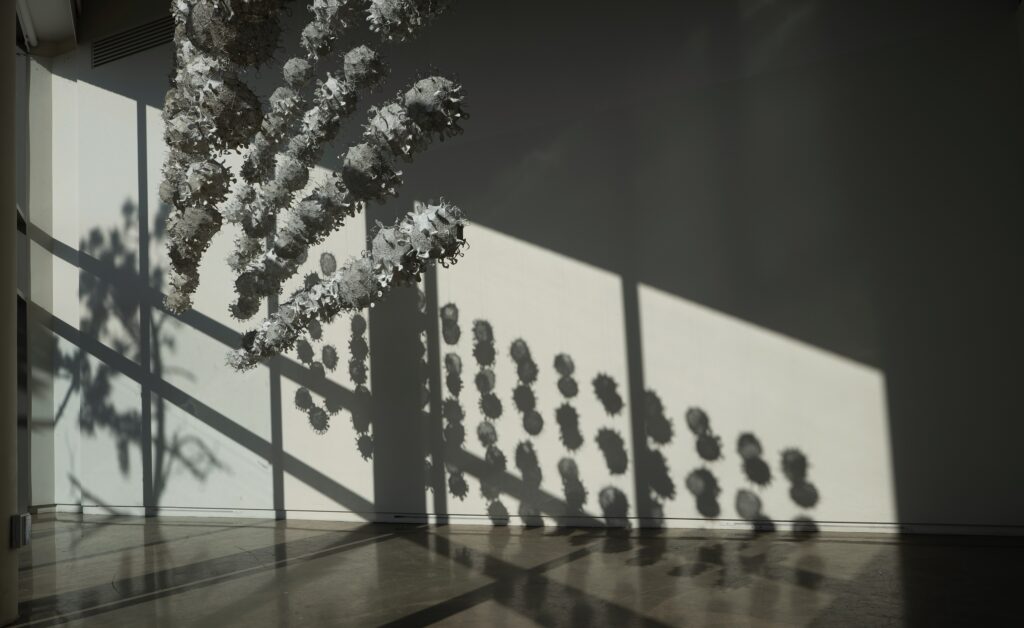
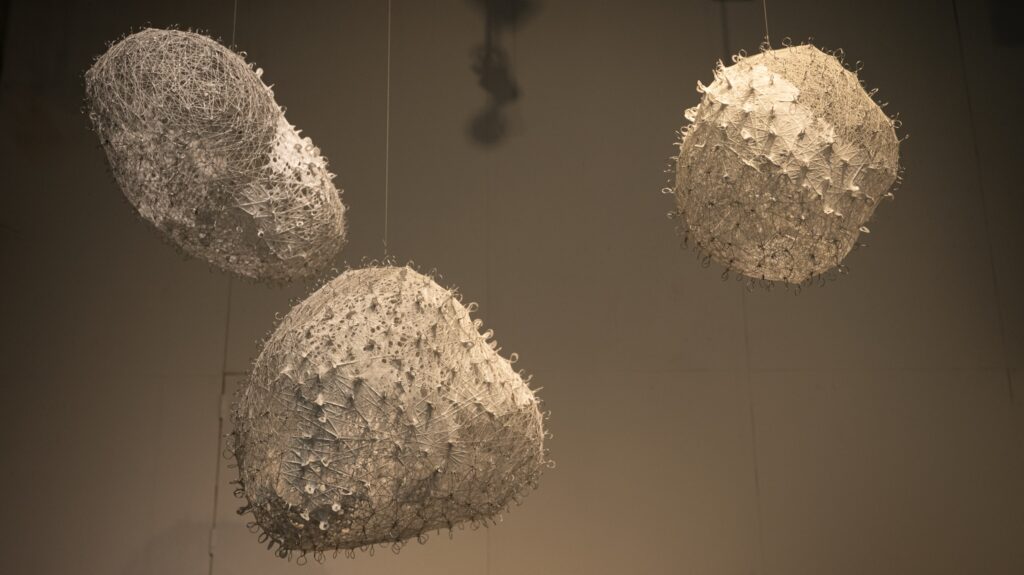
건축 회사 지랩Z_Lab과 첫 건축 프로젝트를 하게 됐을 때예요. 건축주가 CF 감독 일을 하시다 보니 조명에 매우 민감하셨어요. 1년 전부터 조명을 찾고 있었는데 제 작품을 보시고 구 안에 전구를 넣으면 조명이 될 것 같다고 하셨어요. 처음에는 작품이 단순한 기능으로 환원되는 것이 불편했습니다. 그러던 어느 날 광원을 작품 가까이 가져다 대 보니, 한지의 결이 벽에 그림자를 만드는 거예요. 제가 의도하지 않았던 새로운 레이어가 생겨났습니다. 조형 작품으로는 전달되지 못했던 부분이 빛의 힘을 빌려 마무리되는 느낌이었죠. 그때부터 조명이 작품이 됐고, 작품은 공간으로 확장되었습니다.
Hanji is often associated with craft, yet you have expanded it into installation and lighting work. What led you to create these pieces?
The first architectural project I participated in was led by the construction company Z_Lab. The client, an advertising director, was very particular about the lighting fixtures and had been searching for over a year. One day, he suggested that we place a light bulb inside a sphere
I had made. At first, I was uncomfortable with the idea of my work being reduced to a purely functional object. But when I held a light source close to the sphere and saw the texture of the Hanji cast shadows on the wall, a new, unintended layer emerged. It felt as though an aspect that couldn’t be conveyed through the sculptural work alone was being completed through the power of light. From that moment on, lighting became a part of my work, and the artwork expanded into three-dimensional space.
조명 작업을 할 때 특별히 고려하는 부분이 있나요?
그림자의 음영을 어떻게 만들 것인지, 어느 부분에 레이어를 더해 대비를 조절할 것인지를 먼저 고민합니다. 조명을 켜면 공간에 선이 가득 차는 것 같아요. 거리에 따라 그림자의 선명도도 달라지고, 그림자의 질감이 쌓이면서 공간이 훨씬 더 깊어 보이죠. 이는 한국 수묵화의 농담(濃淡)과 닮았습니다. 또한 빛이 없을 때에도 조명이 아닌 조형물로서 완결성을 갖추어야 하므로, 꺼진 상태에서도 아름다워야 한다는 것이 제 기준입니다.
한지를 공예가 아닌 설치로 풀어내는 것, 그 경계에서 어떤 고민이 있었나요?
저는 원래 순수미술 분야에서 시작했기 때문에 쓰임을 고려해본 적이 없었어요. 그런데 작업하다 보니 설치 작가와 공예 작가 그 사이를 넘나들고 있는 저를 발견하게 되었습니다. 처음에는 공예 작가로 불리는 것이 한 길만 연구해온 공예가들에게 죄송스럽기도 했어요. 그러나 결국 한지의 물성을 끊임없이 연구하고 실험해온 저 역시 다르지 않다는 사실을 인정하기까지 시간이 필요했습니다. 영역을 구분하기보다는 그 순간에 필요한 작업을 하는 거예요. 저는 제가 전하고 싶은 이야기를 한지가 가장 잘 담을 수 있기 때문에 이 재료를 사용하고 있을 뿐입니다.
그렇다면 공간에 작품을 놓을 때 가장 중요하게 생각하는 게 무엇인가요?
건축주와의 인터뷰가 먼저입니다. 이 공간이 건축주에게 어떤 의미인지 아는 것이 정말 중요하거든요. 진심이 느껴지지 않는 공간에는 저 역시 온전히 몰입하기 어렵죠. 간혹 제 작품만을 공간의 주인공으로 생각하시는 분들이 계세요. 그럴 때면 이 공간의 주인공은 제가 아니라 건축주라는 점을 분명히 말씀드립니다. 그 공간이 품고 있는 역사와 기억을 읽고 나서야 비로소 작업이 시작됩니다.
What aspects do you pay special attention to when working on lighting projects?
I first consider how shadows will form and where layers should be added to adjust the contrast. When I turn on the light, the space seems to fill with lines. The sharpness of the shadows varies depending on the distance, and the space appears much deeper as the textures of the shadows overlap. This resembles the gradations of light and dark found in traditional Korean ink wash painting. Additionally, the work must maintain its completeness and beauty as a sculptural object even when the lights are off.
What challenges arise when working with Hanji beyond craft, particularly in installation?
I began my career in fine art, so I had never really considered the practical applications of my work. But I found myself straddling the line between installation art and craft as I continued my creative work. At first, I felt guilty about being referred to as a craft artist, as if I were doing a disservice to those who had dedicated their entire careers to the craft. However, I came to acknowledge that I am indeed a craft artist as well, having spent years researching and experimenting with the physical properties of Hanji. Rather than drawing lines between disciplines, I simply do whatever the moment calls for. I use Hanji simply because it is the material best suited to carry the story I want to tell.
What matters most when you create work for a specific space?
The first step is always a conversation with the client. It is essential to understand what the space means to them. Personally, I find it difficult to fully engage with a space that doesn’t feel authentic. Sometimes, I meet clients who think my work should be the star of the space. I always make it clear that the protagonist of the space is the client, not me or my work. After the interview, I interpret the history and memories embedded in that space before starting my work.
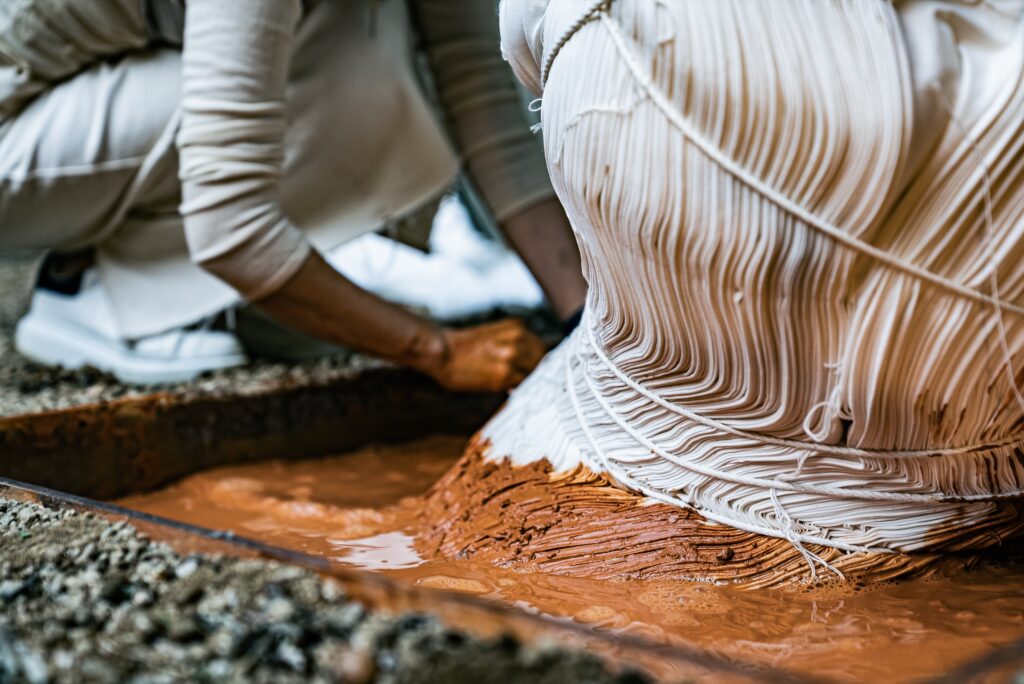
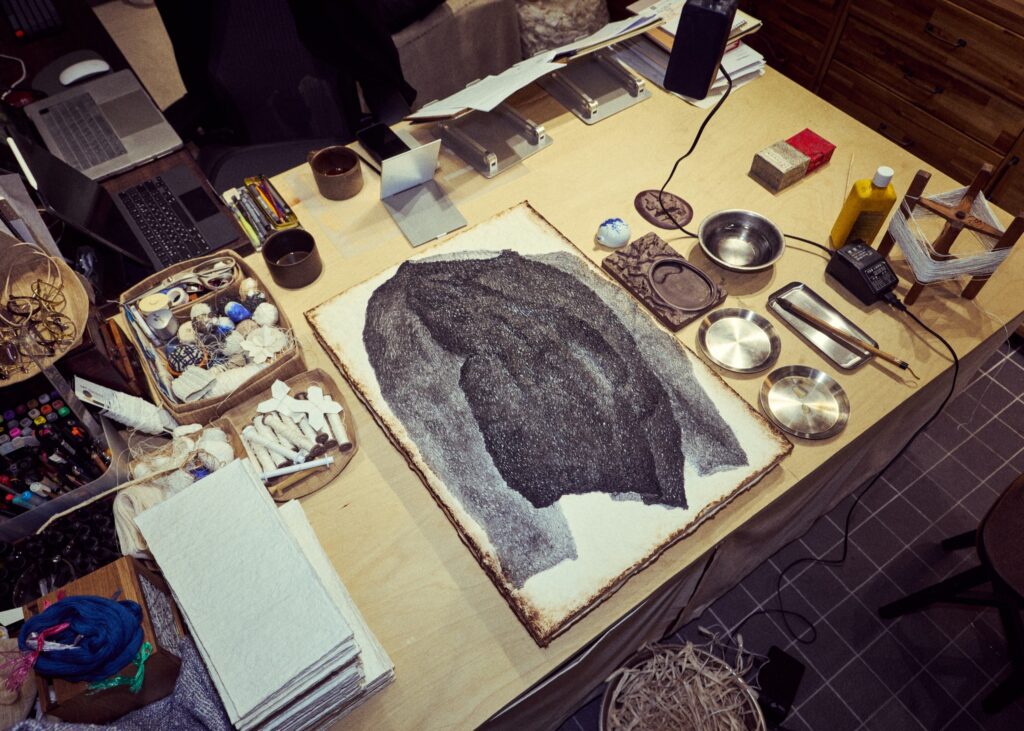
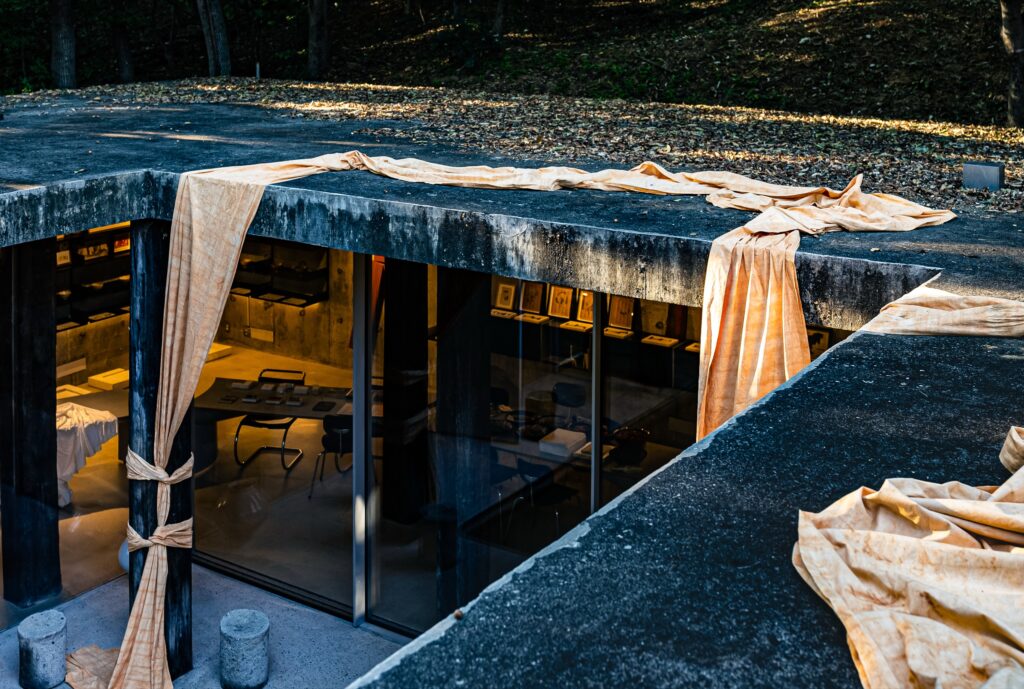
실제로 장소의 기억을 작품에 담은 사례가 있나요?
경주 스테이 ‘시래’ 작업을 할 때는 아버지가 농사를 지으며 남긴 쌀겨를 한지 종이죽에 섞어 넣었습니다. 아버지의 흔적을 작품 안에 담고 싶었거든요. 부안 ‘파란 곳간’에서는 건축가 조병수 선생님과 협업했는데, 이전 세대의 창고 위에 자식 세대가 이어가는 공간의 서사를 담았어요. 재생 건축이라는 것 자체가 흔적을 보호하고 보존하는 일이기도 하고, 저 역시 늘 흔적이라는 주제로 작업해왔으니 그 공간에 제 작품이 들어가면 잘 어울릴 것 같다는 생각이 들었습니다.
최근 개인전 ‘다양체’도 그 연장선에 있나요?
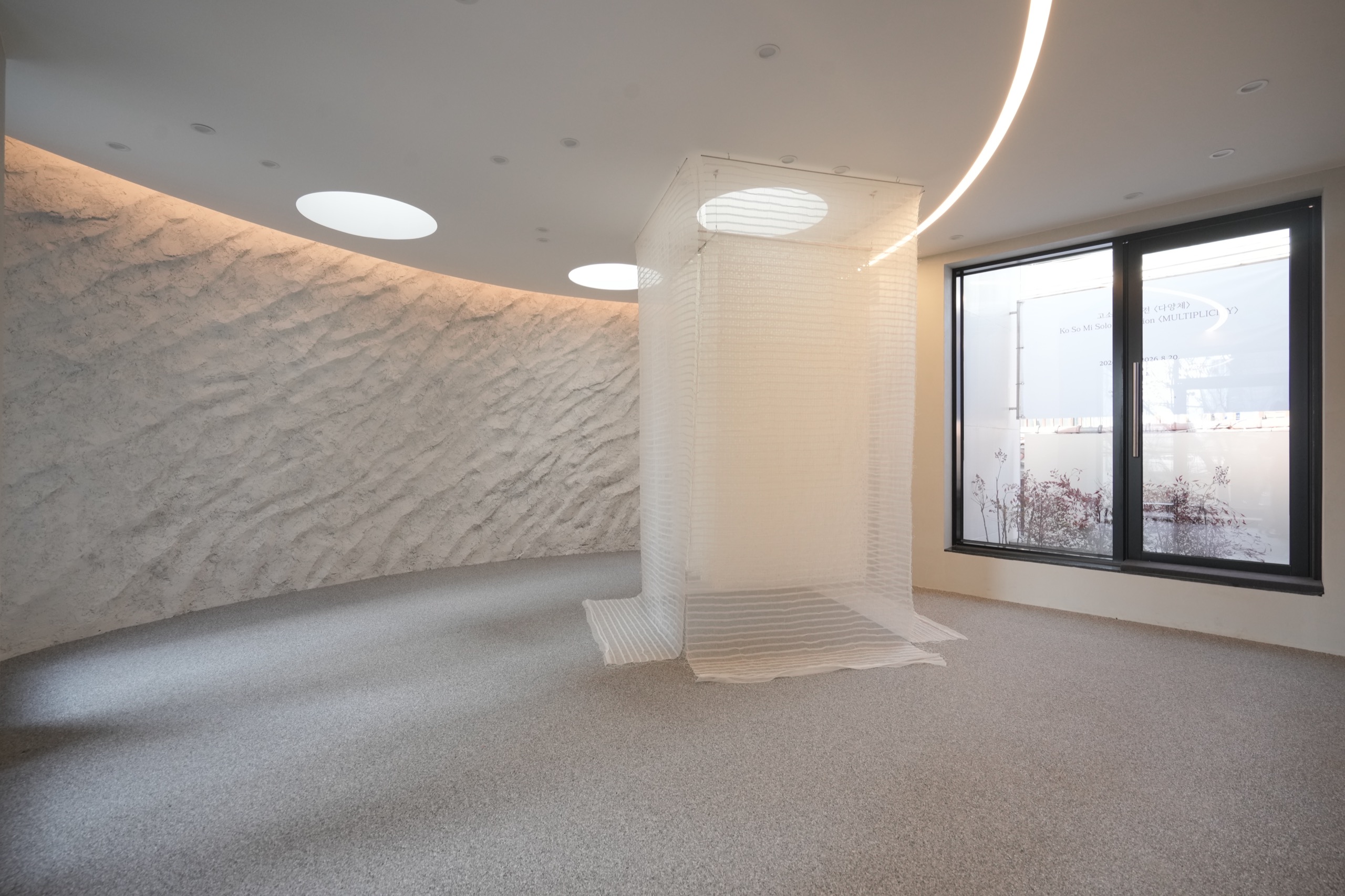
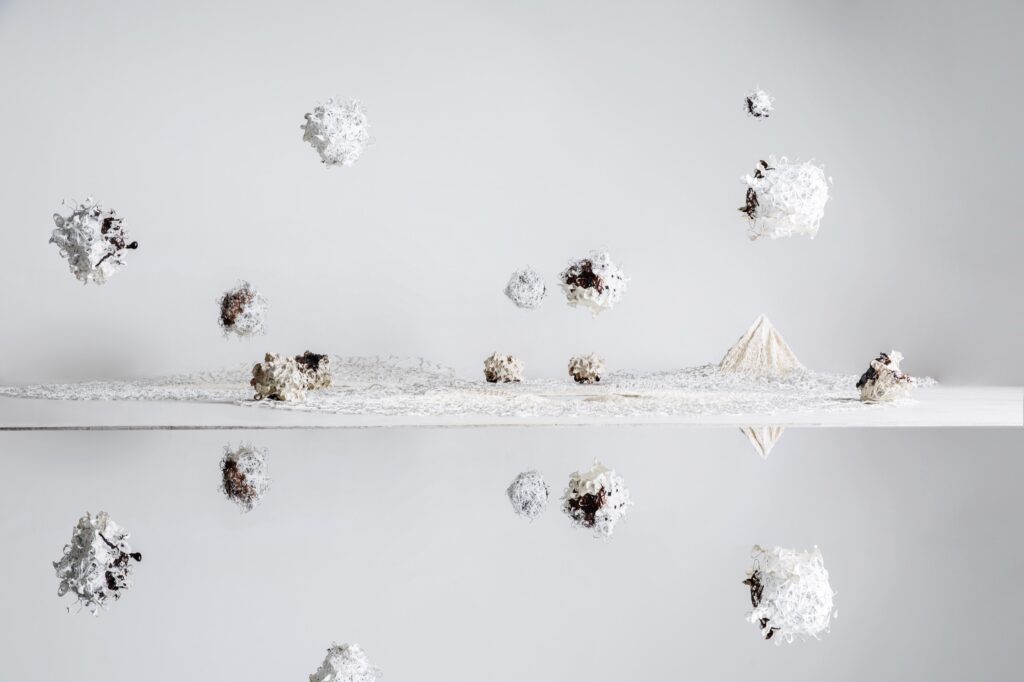
‘다양체’는 공간 자체가 하나의 서사였습니다. 빛이 틈새로 스며드는 지하는 다양체들의 태동을, 쇼윈도를 통해 안과 밖이 동시에 보이는 1층은 서로 영향을 주고받으며 시간을 횡단하는 공간을, 자연광이 들어오는 2층은 다시 자연으로 흡수되는 다양체의 모습을 담도록 구성했어요. 노출 콘크리트라는 차갑고 단단한 공간 안에 한지라는 부드럽고 따뜻한 재료를 두었을 때, 그 극명한 대비가 가져오는 울림이 반드시 있을 것이라고 생각했습니다.
Tell me about your work which incorporated the memories of the space.
When I worked on the Gyeongju Stay ‘Sirae’ project, I mixed rice bran left over from my father’s farm into the Hanji paper pulp to capture my father’s legacy within the work. For the ‘Blue Barn’ project in Buan, I collaborated with renowned architect Cho Byoung Soo. The project involved turning an old grain barn into a café, and we captured the narrative of the space by preserving the original structure and atmosphere of the barn. I felt that my work would fit well within that space since regenerative architecture itself involves protecting and preserving traces, which has always been the focus of my work.
Does your recent solo exhibition “Multiplicity” extend this line of thought?
In Multiplicity, the space itself carried the narrative. The basement, where light seeps through the openings, represents the birth of multiplicity. The first floor, where the interior and exterior could be seen at once through the storefront windows, depicted a space moving through time as inside and outside influenced one another. The second floor, bathed in natural light, captured Multiplicity returning to nature. I thought the stark contrast between Hanji, a soft and warm material, and the cold, hard space of exposed concrete would inevitably create a unique resonance.
‘다양체’라는 개념은 어디서 왔나요?
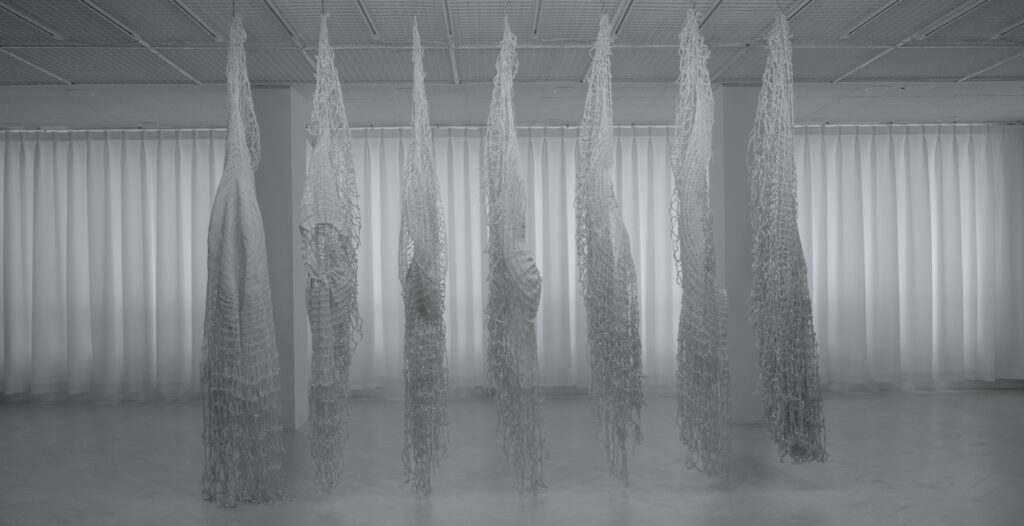
제가 소중하게 여겼던 존재를 잃은 뒤, 그 상실감에서 쉽게 벗어나지 못했던 시간이 있었습니다. 와이어로 구를 만드는 작업을 하는데, 수작업이다 보니 모두 다른 형태가 돼요. 똑같이 만들고 싶어도 그럴 수 없죠. 각기 다른 형태가 자기만의 고유한 모습을 가진 우리를 대변한다고 생각합니다. 대량생산에 익숙해진 세상에선 기준을 벗어나면 하자로 분류되곤 하잖아요. 그러나 생명체에는 그런 기준을 적용할 수 없어요. 오히려 서로 다른 모습을 지니기 때문에 더 큰 가치를 갖습니다. 그저 존재하는 것만으로도 충분히 존엄하다는 사실을 이야기하고 싶었습니다.
마지막으로 한지라는 재료로 설치 작업을 한다는 것, 결국 작가님에게는 어떤 의미인가요?
전통을 이어간다는 것은 두 가지 의미를 지닙니다. 하나는 물리적으로 보존하고 계승하는 장인의 역할이며, 다른 하나는 그 정신을 동시대의 서사로 번역하는 창작자의 역할입니다. 저는 후자의 역할을 맡고 싶습니다. 한지가 창호지로, 그림이나 글의 바탕으로만 쓰이던 시대는 지났습니다. 그러나 그 재료가 품고 있는 시간과 정신은 여전히 살아 있습니다. 설치 작품 안에서, 공간 안에서, 그리고 빛과 그림자 사이에서. 그것이 제가 생각하는 오래된 재료의 새로운 언어입니다.
Where did the concept of ‘Multiplicity’ originate from?
It comes from a realization that occurred to me during a period when I was experiencing a profound sense of loss from losing someone I cherished. I work with wires to create spheres, and they all end up looking different because I make them with my own hands. I couldn’t make them identical even if I tried. I believe these distinct forms represent us, each with our own singular shape. In a world accustomed to mass production, anything that deviates from the standard is often classified as a defect. But you can’t apply such standards to living beings.
On the contrary, each individual holds great value precisely because they are all different. I wanted to convey that existence itself is dignity.
What does creating installation art using Hanji mean to you as an artist?
I think carrying on heritage has two meanings. One is the role of the artisan, who physically preserves and passes it down, and the other is the role of the creator, who translates the spirit imbued in heritage into a contemporary narrative. I wish to take on the latter role. The era when Hanji was used solely as window paper or as a medium for paintings and writing has passed. Yet the time and spirit embodied in this material are still alive in installations, in space, and between light and shadow. That is what I consider to be the new ‘language’ of an ancient material.
고소미 설치 아티스트
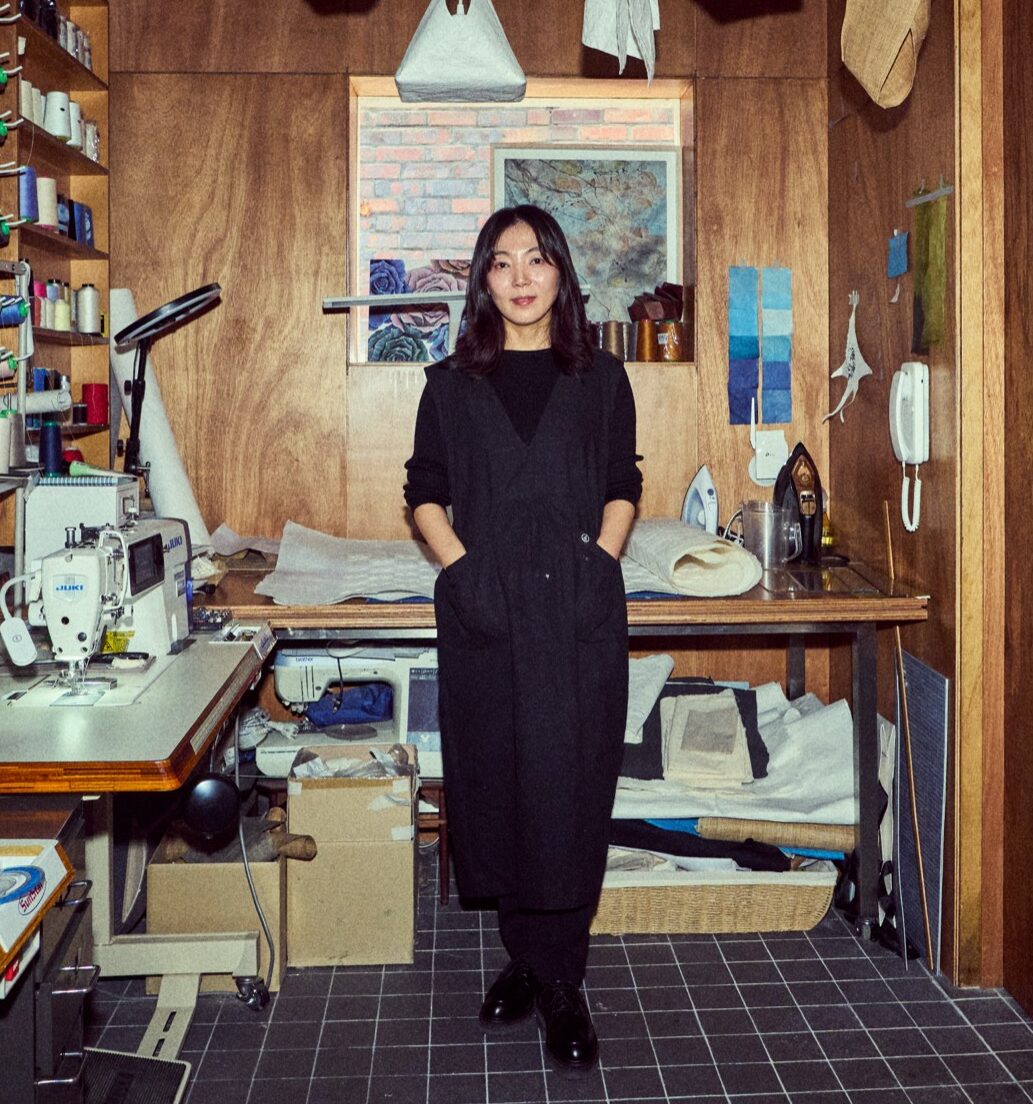
동양화를 전공한 후 무사시노미술대학원에서 13년간 한지의 물성과 섬유 구조를 연구했다. 닥섬유의 현미경 분석부터 강도 실험, 염색 테스트까지 과학적 연구를 바탕으로 한지를 물레로 꼬아 만든 고유한 실 ‘소미사小魅絲, SOMISA’를 개발했다. 이를 토대로 회화와 설치, 조명을 아우르는 작업 세계를 전개하고 있으며, 건축가 조병수와의 협업을 비롯해 국내외 다양한 공간에서 설치 작업을 선보이고 있다.
Ko Somi
After majoring in East Asian painting, she spent 13 years studying at Musashino Art University in Japan. She developed ‘SOMISA,’ a unique thread spun on a spinning wheel using Hanji, based on her research work involving microscopic analysis of mulberry fibers, strength tests and dyeing experiments. Building on this foundation, she has expanded her artistic practice to encompass painting, installation, and lighting, and she has presented her work both in Korea and overseas. She has also collaborated with architects including Cho Byoung Soo.
Epilogue
고소미의 작업실에서 돌아오는 길에, 실 한 올의 무게에 대해 생각했습니다. 닥나무가 1년을 자라고, 장인이 30년간 종이를 뜨고, 작가가 그 종이를 잘라 꼬아 만든 한 올. 그 안에 얼마나 많은 사람의 시간이 겹쳐 있는지, 그리고 그 시간 위에 새로운 가능성을 더하기 위해, 그녀는 지금도 한지를 실로 바꾸는 실험을 반복하고 있습니다. 그녀는 말했습니다. “한지로 실을 꼬을 때 같은 동작을 반복하면서 잡생각이 자연스레 사라져요. 제게 한지는 비움을 주는 재료인 것 같아요.” 비움. 그것이 헤리티지의 역설입니다. 전통은 과거에 묶인 것이 아니라, 현재에 살아 숨 쉬며 미래로 이어지는 것이라는 듯, 그녀의 실 한 올은 오늘도 조용히 헤리티지를 이어가고 있습니다.
On my way back from Ko Somi’s studio, I found myself thinking about the weight of a single thread of SOMISA. It takes a year to grow a paper mulberry tree, and the skill of a master craftsperson with more than 30 years of experience to make Hanji. It then takes an artist to cut and twist that Hanji to make a single thread. It is remarkable how many layers of human time it holds, and how Ko Somi continues to add new possibilities on top of them, repeating her experiments of transforming Hanji into thread. She said: “When I am twisting Hanji into thread, repeating the same motion, my wandering thoughts naturally fade away. To me, Hanji is a material that allows me to empty myself.” Her work reveals, almost paradoxically, that tradition is not bound to the past but lives and breathes in the present, extending into the future, one thread at a time.